The Scientific American cyclopedia of formulas : partly based upon the twenty-eighth edition of Scientific American cyclopedia of receipts, notes and queries 15,000 formulas / edited by Albert A. Hopkins.
- Albert A. Hopkins
- Date:
- 1910
Licence: Public Domain Mark
Credit: The Scientific American cyclopedia of formulas : partly based upon the twenty-eighth edition of Scientific American cyclopedia of receipts, notes and queries 15,000 formulas / edited by Albert A. Hopkins. Source: Wellcome Collection.
49/1096 page 35
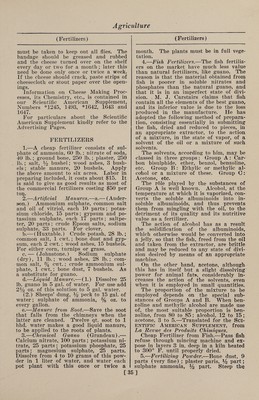
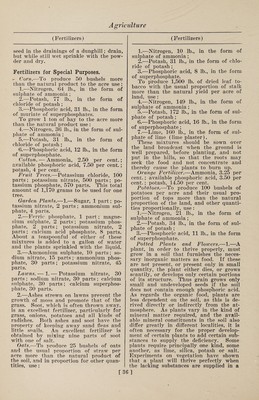
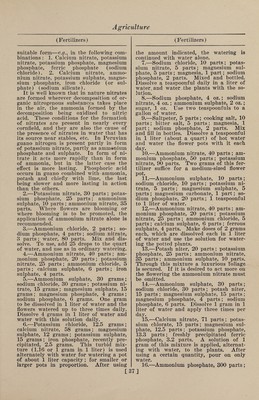
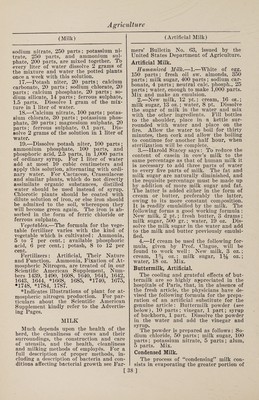
![must be taken to keep out all flies. The bandage should be greased and rubbed and the cheese turned over on the shelf every day or two for a month ; later this need be done only once or twice a week. If the cheese should crack, paste strips of cheesecloth or stout paper over the open¬ ings. Information on Cheese Making Proc¬ esses, its Chemistry, etc., is contained in our Scientific American Supplement, Numbers *1245, 1493, *1642, 1643 and 1647. For particulars about the Scientific American Supplement kindly refer to the Advertising Pages. FERTILIZERS 1. —A cheap fertilizer consists of sul¬ phate of ammonia, 60 lb.; nitrate of soda, 40 lb.; ground bone, 250 lb.; plaster, 250 lb.; salt, % bushel; wood ashes, 3 bush¬ els ; stable manure, 20 bushels. Apply the above amount to six acres. Labor in preparing included, it costs about $15. It is said to give as good results as most of the commercial fertilizers costing $50 per ton. 2. —Artificial Manures.—a.— (Ander¬ son.) Ammonium sulphate, common salt and oil of vitriol, each 10 parts; potas¬ sium chloride, 15 parts; gypsum and po¬ tassium sulphate, each 17 parts; saltpe¬ ter, 20 parts ; crude Epsom salts, sodium sulphate, 33 parts. For clover. b. — (Huxtable.) Crude potash, 28 lb.; common salt, 1 cwt.; bone dust and gyp¬ sum, each 2 cwt.; wood ashes, 15 bushels. For either corn, turnips or grass. c. — (Johnstone.) Sodium sulphate (dry), 11 lb.; wood ashes, 28 lb.; com¬ mon salt, % cwt.; crude ammonium sul¬ phate, 1 cwt.; bone dust, 7 bushels. As a substitute for guano. d. —Liquid Manure.— (1.) Dissolve 25 lb. guano in 5 gal. of water. For use add 2% oz. of this solution to 5 gal. water. (2.) Sheeps’ dung, % peck to 15 gal. of water; sulphate of ammonia, % oz. to every gallon. e. —Manure from Soot.—Save the soot that falls from the chimneys when the latter are cleaned. Twelve qt. soot to 1 hhd. water makes a good liquid manure, to be applied to the roots of plants. 3. —Chemical Guano (Grandeau).— Calcium nitrate, 100 parts; potassium ni¬ trate, 25 parts; potassium phosphate, 25 parts; magnesium sulphate, 25 parts. Dissolve from 4 to 10 grams of this pow¬ der in 1 liter of water, and water each pot plant with this once or twice a month. The plants must be in full vege¬ tation. 4. —Fish Fertilizers.—The fish fertiliz¬ ers on the market have much less value than natural fertilizers, like guano. The reason is that the material obtained from fish is poorer in soluble nitrates and phosphates than the natural guano, and that it is in an imperfect state of divi¬ sion. M. J. Carstairs claims that fish contain all the elements of the best guano, and its inferior value is due to the loss produced in the manufacture. He has adopted the following method of prepara¬ tion, consisting essentially in submitting the fish, dried and reduced to pieces, in an appropriate extractor, to the action of a mixture, in the state of vapor, of a solvent of the oil or a mixture of such solvents. The solvents, according to him, may be classed in three groups : Group A: Car¬ bon bisulphide, ether, benzol, benzoline, etc. Group B: Ethylic or methylic al¬ cohol or a mixture of these. Group G : Acetone, etc. The role played by the substances of Group A is well known. Alcohol, at the temperature at which it is vaporized, con¬ verts the soluble albuminoids into in¬ soluble albuminoids, and thus prevents them from mingling with the oil, to the detriment of its quality and its nutritive value as a fertilizer. The action of alcohol has as a result the solidification of the albuminoids, which otherwise would be converted into a jelly, so that the fish, freed from the oil and taken from the extractor, are brittle and may be reduced to any state of divi¬ sion desired by means of an appropriate machine. .On the. other hand, acetone, although this has in itself but a slight dissolving power for animal fats, considerably in¬ creases the action of the solvents, even when it is employed in small quantities. The proportion of the mixture to be employed depends on the special sub¬ stances of Groups A and B. When ben¬ zoline and methylic alcohol are made use of, the most suitable proportion is ben¬ zoline, from 80 to 85; alcohol, 12 to 15; acetone, 3 to 5.—Translated for the Sci¬ entific American Supplement, from La Revue des Produits Chimiques. Cheap Fertilizer from Fish.—Pass fish refuse through mincing machine and ex¬ pose in layers 3 in. deep in a kiln heated to 300° F. until properly dried. 5. —Fertilizing Powder.—Bone dust, 9 parts (very fine) ; plaster paris, % part; sulphate ammonia, % part. Steep the [35]](https://iiif.wellcomecollection.org/image/b31361523_0049.jp2/full/800%2C/0/default.jpg)