The Scientific American cyclopedia of formulas : partly based upon the twenty-eighth edition of Scientific American cyclopedia of receipts, notes and queries 15,000 formulas / edited by Albert A. Hopkins.
- Albert A. Hopkins
- Date:
- 1910
Licence: Public Domain Mark
Credit: The Scientific American cyclopedia of formulas : partly based upon the twenty-eighth edition of Scientific American cyclopedia of receipts, notes and queries 15,000 formulas / edited by Albert A. Hopkins. Source: Wellcome Collection.
50/1096 page 36
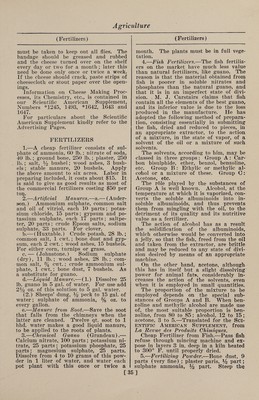
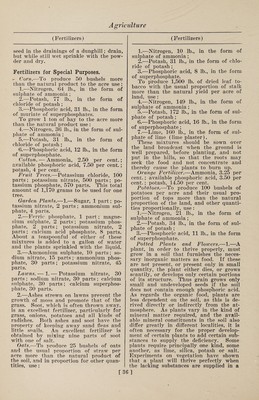
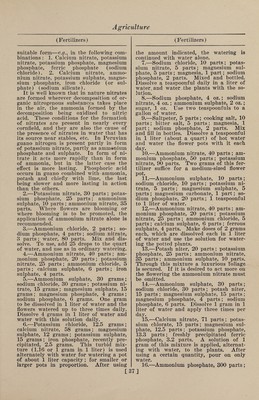
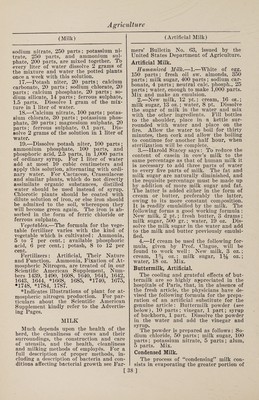
![seed in the drainings of a dunghill; drain, but while still wet sprinkle with the pow¬ der and dry. Fertilizers for Special Purposes. - Corn.—To produce 50 bushels more than the natural product to the acre use: 1. —Nitrogen, 64 lb., in the form of sulphate of ammonia ; 2. —Potash, 77 lb., in the form of chloride of potash ; 3. —Phosphoric acid, 31 lb., in the form of muriate of superphosphates. To grow 1 ton of hay to the acre more than the natural product use: 4. —Nitrogen, 36 lb., in the form of sul¬ phate of ammonia ; 5. —Potash, 31 lb., in the form of chloride of potash ; 6. —Phosphoric acid, 12 lb., in the form of superphosphate. Cotton. — Ammonia, 2.50 per cent.; available phosphoric acid, 7.50 per cent.; potash, 4 per cent. Fruit Trees.—Potassium chloride, 100 parts ; potassium nitrate, 500 parts; po¬ tassium phosphate, 570 parts. This total amount of 1,170 grams to be used for one tree. Garden Plants.—1.—Sugar, 1 part; po¬ tassium nitrate, 2 parts; ammonium sul¬ phate, 4 parts. < 2.—Ferric phosphate, 1 part; magne¬ sium sulphate, 2 parts ; potassium phos¬ phate, 2 parts; potassium nitrate, 2 parts; calcium acid phosphate, 8 parts. About a teaspoonful of either of these mixtures is added to a gallon of water and the plants sprinkled with the liquid. 3.—Ammonium sulphate, 10 parts; so¬ dium nitrate, 15 parts ; ammonium phos¬ phate, 30 parts; potassium nitrate, 45 parts. Lawns. — 1. — Potassium nitrate, 30 parts; sodium nitrate, 30 parts ; calcium sulphate, 30 parts; calcium superphos¬ phate, 30 parts. 2.—Ashes strewn on lawns prevent the growth of moss and promote that of the grass. Soot, which is often thrown away, is an excellent fertilizer, particularly for grass, onions, potatoes and all kinds of radishes. Both ashes and soot have the property of keeping away sand fleas and little snails. An excellent fertilizer is obtained by mixing nine parts of soot with one of salt. Oats.—To produce 25 bushels of oats and the usual proportion of straw per acre more than the natural product of the soil, and in proportion for other quan¬ tities, use: 1. —Nitrogen, 10 lb., in the form of sulphate of ammonia; 2. —Potash, 31 lb., in the form of chlo¬ ride of potash ; 3. —Phosphoric acid, 8 lb., in the form of superphosphate. To produce 1,500 lb. of dried leaf to¬ bacco with the usual proportion of stalk more than the natural yield per acre of land, use : 4. —Nitrogen, 149 lb., in the form of sulphate of ammonia; 5. —Potash, 172 lb., in the form of sul¬ phate of potash ; 6. —Phosphoric acid, 16 lb., in the form of superphosphate; 7. —Lime, 160 lb., in the form of sul¬ phate of lime (lime plaster). These mixtures should be sown over the land broadcast when the ground is well prepared, before planting, and not put in the hills, so that the roots may seek the food and not concentrate and thereby cause the plants to burn up. Orange Fertilizer.—Ammonia, 3.25 per cent.; available phosphoric acid, 3.50 per cent. ; potash, 14.50 per cent. Potatoes.—To produce 100 bushels of potatoes per acre and their usual pro¬ portion of tops more than the natural proportion of the land, and other quanti¬ ties proportionally, use : 3.—Nitrogen, 21 lb., in the form of sulphate of ammonia; 2. —Potash, 34 lb., in the form of sul¬ phate of potash ; 3. —Phosphoric acid, 11 lb., in the form of superphosphate. Potted Plants and Flowers.—1.—A plant, in order to thrive properly, must grow in a soil that furnishes the neces¬ sary inorganic matters as food. If these are not present, or present only in small quantity, the plant either dies, or grows scantily, or develops only certain portions of its structure. Thus grain grows only small and undeveloped seeds if the soil does not contain enough phosphoric acid. As regards the organic food, plants are less dependent on the soil, as this is de¬ rived directly or indirectly from the at¬ mosphere. As plants vary in the kind of mineral matter required, and the avail¬ able mineral constituents in the soil also differ greatly in different localities, it is often necessary for the proper develop¬ ment of certain plants to add certain sub¬ stances to supply the deficiency. Some plants require principally one kind, some another, as lime, silica, potash or salt. Experiments on vegetation have shown that a plant will thrive perfectly when the lacking substances are supplied in a [36]](https://iiif.wellcomecollection.org/image/b31361523_0050.jp2/full/800%2C/0/default.jpg)