The Scientific American cyclopedia of formulas : partly based upon the twenty-eighth edition of Scientific American cyclopedia of receipts, notes and queries 15,000 formulas / edited by Albert A. Hopkins.
- Albert A. Hopkins
- Date:
- 1910
Licence: Public Domain Mark
Credit: The Scientific American cyclopedia of formulas : partly based upon the twenty-eighth edition of Scientific American cyclopedia of receipts, notes and queries 15,000 formulas / edited by Albert A. Hopkins. Source: Wellcome Collection.
52/1096 page 38
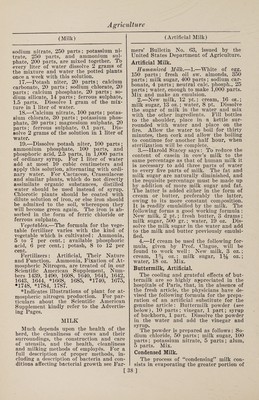
![(Milk) sodium nitrate, 250 parts ; potassium ni¬ trate, 250 parts, and ammonium sul¬ phate, 200 parts, are mixed together. To every liter of water dissolve 2 gyams of the mixture and water the. potted plants once a week with this solution. 17. —Potash niter, 20 parts; calcium carbonate, 20 parts; sodium chlorate, 20 parts; calcium phosphate, 20 parts; so¬ dium silicate, 14 parts; ferrous sulphate, 1.5 parts. Dissolve 1 gram of the mix¬ ture in 1 liter of water. 18. —Calcium nitrate, 100 parts; potas¬ sium chlorate, 30 parts; potassium phos¬ phate, 30 parts ; magnesium sulphate, 20 parts; ferrous sulphate, 0.1 part. Dis¬ solve 2 grams of the solution in 1 liter of water. 19. —Dissolve potash niter, 100 parts; ammonium phosphate, 100 parts, and phosphoric acid, 2.5 parts, in 1,000 parts of ordinary syrup. For 1 liter of water add at most 10 cubic centimeters and apply this solution, alternating with ordi¬ nary water. For Cactacese, Crassulacese and similar plants, which do not directly assimilate organic substances, distilled water should be used instead of syrup. Chlorotic plants should be coated with dilute solution of iron, or else iron should be admixed to the soil, whereupon they will become green again. The iron is ab¬ sorbed in the form of ferric chloride or ferrous sulphate. Vegetables.—The formula for the vege¬ table fertilizer varies with the kind of vegetable which is cultivated: Ammonia, 5 to 7 per cent.; available phosphoric acid, 6 per cent.; potash, 8 to 12 per cent. Fertilizers: Artificial, Their Nature and Function. Ammonia, Fixation of At¬ mospheric Nitrogen, are treated of in our Scientific American Supplement, Num¬ bers 1439, 1490, 1608, 1640, 1641, 1642, 1643, 1644, *1668, 1685, *1740, 1675, *1748, *1784, 1787. *Indicates illustrations of plant for at¬ mospheric nitrogen production. For par¬ ticulars about the Scientific American Supplement kindly refer to the Advertis¬ ing Pages. MILK Much depends upon the health of the herd, the cleanliness of cows and their surroundings, the construction and care of utensils, and the health, cleanliness and milking methods of employes. For a full description of proper methods, in¬ cluding a description of bacteria and con¬ ditions affecting bacterial growth see Far- (Artificial Milk) mers’ Bulletin No. 63, issued by the United States Department of Agriculture. Artificial Milk. Humanized Milk.—1.—White of eg_g, 150 parts; fresh oil sw. almonds, 350 parts ; milk sugar, 400 parts ; sodium car¬ bonate, 4 parts; neutral calc, phosph., 25 parts; water, enough to make 1,000 parts. Mix and make an emulsion. 2. —New milk, 12 pt.; cream, 16 oz.; milk sugar, 13 oz.; water, 8 pt. Dissolve the sugar of milk in the water and mix with the other ingredients. Fill bottles to the shoulder, place in a kettle sur¬ rounded with water and place on the fire. Allow the water to boil for thirty minutes, then cork and allow the boiling to continue for another half hour, when sterilization will be complete. 3. —Harold StaCey says : To reduce the content of casein in cow’s milk to the same percentage as that of human milk it is necessary to add three parts of water to every five parts of milk. The fat and milk sugar are naturally diminished, and the requisite percentage must be made up by addition of more milk sugar and fat. The latter is added either in the form of cream or butter, preferably the latter, owing to its more constant composition. It is readily emulsified by the milk. The following forms a good working formula : New milk, 2 pt.; fresh butter, 3 drams ; milk sugar, 500 gr.; water, 19 oz. Dis¬ solve the milk sugar in the water and add to the milk and butter previously emulsi¬ fied. 4. —If cream be used the following for¬ mula, given by Prof. Clague, will be found to work well: New milk, 3 oz.; cream, 1% oz.; milk sugar, 1% oz.; water, 18 oz. Mix. Buttermilk, Artificial. The cooling and grateful effects of but¬ termilk are so highly appreciated in the hospitals of Paris, that, in the absence of the fresh article, the physicians have de¬ vised the following formula for the prepa¬ ration of an artificial substitute for the genuine article: Buttermilk powder (see below), 10 parts; vinegar, 1 part; syrup of buckhorn, 1 part. Dissolve the powder in the water and add the vinegar and syrup. The powder is prepared as follows : So¬ dium chloride, 50 parts; milk sugar, 100 parts; potassium nitrate, 5 parts; alum, 5 parts. Mix. Condensed Milk. The process of “condensing” milk con¬ sists in evaporating the greater portion of [38]](https://iiif.wellcomecollection.org/image/b31361523_0052.jp2/full/800%2C/0/default.jpg)