The Scientific American cyclopedia of formulas : partly based upon the twenty-eighth edition of Scientific American cyclopedia of receipts, notes and queries 15,000 formulas / edited by Albert A. Hopkins.
- Albert A. Hopkins
- Date:
- 1910
Licence: Public Domain Mark
Credit: The Scientific American cyclopedia of formulas : partly based upon the twenty-eighth edition of Scientific American cyclopedia of receipts, notes and queries 15,000 formulas / edited by Albert A. Hopkins. Source: Wellcome Collection.
56/1096 page 42
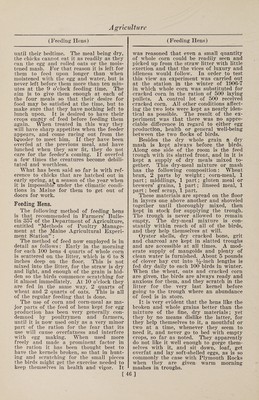
![(Testing Milk) quietly for even a short time, it will be too rich or too poor in fat. The milk must be well and thoroughly mixed before the sample is taken. A good way of doing this is to pour it several times from one vessel to another. This should be con¬ tinued until no lumps or collections of cream appear on the surface. If small particles of butter are floating about, a fair sample cannot be taken. There are several methods of testing milk. A com¬ plete analysis by a chemist will give the exact amount of each component part. This requires considerable time and ex¬ pense, and is not necessary for practical purposes. Babcock Test.—1.—Several methods of rapidly determining the fat\ content of milk with the aid of chemical reagents have been devised. One of the most ac¬ curate is the Babcock milk test.* The little machine constructed to apply this test, and of which several patterns are made, is in use in almost all well-con¬ ducted milk-receiving stations. It re¬ quires about a tablespoonful of milk for a sample, and the exact percentage of fat in it can be determined by this test in ten to fifteen minutes. The result is ob¬ tained by the action of centrifugal force aided by some chemical agents. The original cost of the machine is from $4 to $15, according to size and pattern, and less than 1 cent’s worth of materials are used for each sample. Its manipulation is easily learned, and it can be success¬ fully operated by any careful person. A definite amount (18 gramsf) of the milk or cream to be tested is measured in a pipette and placed in a bottle which has a long, slender, graduated neck (Fig. 1). Sulphuric acid is then added, and the bottle shaken until the mixture becomes dark-colored, which requires but a few* moments. The acid does not affect the fat, but it dissolves the other milk solids which keep the fat globules apart. The bottle is then placed in the ma¬ chine, by which it is rapidly revolved in a horizontal position with the neck toward the center. The fat is thus forced toward the neck by the other contents of the bottle, which are heavier and therefore thrown away from the center to the bot- *Invented by Dr. S. M. Babcock, of the Wisconsin Agricultural Experiment Station, and fully described in bulletins of that and several other experiment stations. fl7.6 c.c. of milk weighs practically 18 grams. Cream is lighter than milk; hence a larger volume must be taken. *For exact results, cream samples should be weighed. [ (Testing Milk) tom of the bottle. Sufficient warm water is added to bring the fat up into the neck, where its exact percentage can be read on the scale. In the illustration a pipette for measuring the milk, the acid measure and a test bottle are shown. From two to twenty-four bottles, contain¬ ing as many different samples, can be tested at a time, according to the size of the machine. Special bottles of a modi¬ fied form are furnished for testing skimmed milk and cream. Apparatus for this test is sold by dairy supply firms. A 17.5 C.C. / c^i> V Fig. 1.—Glassware for the Babcock Milk Test. small machine, complete with the neces¬ sary glassware and acid, can be obtained for $5 or $6. Full directions are sent with the apparatus. These can be easily followed and quite accurate results ob¬ tained after a little practice. A number of other tests which can be quickly and easily made have been de¬ scribed by different investigators. Like the Babcock test, they are for the deter¬ mination of the fat only, but are less sat¬ isfactory. Some testing appliances have been placed on the market with the nec¬ essary chemical agents in bottles desig¬ nated by a letter or number, without in- 42 ]](https://iiif.wellcomecollection.org/image/b31361523_0056.jp2/full/800%2C/0/default.jpg)