The Scientific American cyclopedia of formulas : partly based upon the twenty-eighth edition of Scientific American cyclopedia of receipts, notes and queries 15,000 formulas / edited by Albert A. Hopkins.
- Albert A. Hopkins
- Date:
- 1910
Licence: Public Domain Mark
Credit: The Scientific American cyclopedia of formulas : partly based upon the twenty-eighth edition of Scientific American cyclopedia of receipts, notes and queries 15,000 formulas / edited by Albert A. Hopkins. Source: Wellcome Collection.
62/1096 page 48
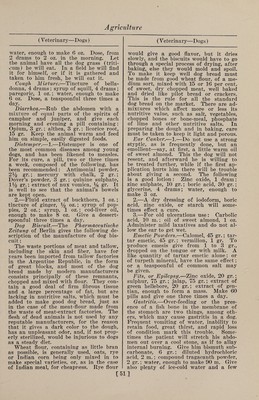
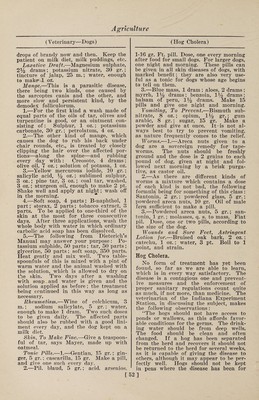
![(Poultry Remedies) cantharides, 1 dram; potassium nitrate, 1 oz. Put a teaspoonful in a quart of food. 7. —jOyster shells in coarse powder, 2,400 parts; calcium carbonate, 380 parts; calcium phosphate, 380 parts; powdered black pepper, 500 parts; pow¬ dered red pepper, 40 parts; iron oxide, 60 parts; chlorides, phosphates and sul¬ phates, soluble in water, 80 parts. 8. —Powdered red pepper, 2 oz.; pow¬ dered allspice, 4 oz.; powdered ginger, 6 oz. Mix by sifting. One tablespoon¬ ful to be mixed with every pound of food and fed two or three times a week. 9. —Mix the following substances thor¬ oughly after they are reduced to a coarse powder: 1 part of sodium chloride, % part of iron sulphate, the same quantity of sodium carbonate and the same quan¬ tity of sulphur. Add 10 parts of lean beef, dried and pulverized, 10 parts of fine sand, 20 parts of Indian corn, and as much linseed cake. Remedies f$r Croup, Gape, Lice, Etc. 1. — Croup. — Potassium chlorate, 2 av.oz.; cubebs, 2 av.oz.; anise, 1 av.oz.; licorice root, 3 av.oz. Reduce all to powder and mix well. Mix a teaspoon¬ ful of this with food for sixty hens. 2. — Gape Cure. — Take a wooden box, a little bigger than a biscuit-tin, and divide it in two by means of a piece of wire netting. Place half of an ordinary brick, made very hot by means of fire, on one side of wire netting and the chicks on the other. Cover the whole box with a cloth, and then insert under the cloth a tablespoon with teaspoonful of car¬ bolic acid. Pour the liquid on to the hot brick and withdraw spoon. The fumes will cure the chicks in two min¬ utes. Take out the chicks just before they are apparently suffocated. Be careful to keep the hands and face away from the liquid when it is poured on to the brick, as it will blister the skin. If chicks are not cured keep them in the fumes longer. b.—Powdered camphor, 4 drams; per¬ oxide of iron, 8 drams; powdered fenu¬ greek, 8 drams; powdered licorice, 3% oz. Mix. Two teaspoonfuls to be mixed with the food of a dozen fowls. 3. —Lice Exterminator.—a.—Make the roosts perfectly clean with hot soap and water, and afterward apply spirits of turpentine or kerosene oil. Also strew some sprigs and branches over the floor (Weight of Eggs) of the coop. The building should be kept clean. b.—Gas tar, 12 oz.; sodium hydroxide, 2 oz.; sulphur, 4 oz.; rosin, 2 oz.; water, 1 gal. Boil the tar with the soda and some of the water; add the rosin; after dissolving, add the sulphur and the bal¬ ance of the water. 4. —Roup.—a.—Licorice, 2 oz.; anise, 1 oz.; cubebs, 1 oz.; capsicum, 10 gr.; potass, chlorate, 1 oz. The ingredients, all in fine powder, should be intimately mixed. b.—Calomel, 1 dram; antimonial pow¬ der, 1 dram ; powdered licorice, 1 dram; copaiba, enough. Make sixty pills, and give one night and morning. 5. —Tonic Pills for Pigeons and Poul¬ try.—The following two formulas are from the Pharmaceutical Journal: a.— Red cinchona bark, 1 gr.; extract of calumba, 60 gr.; extract of chamomile, 60 gr.; extract of gentian, 60 gr. Mix. Dose, 4 to 12 grains. b. —Ferrous sulphate, 60 gr.; extract of jaborandi, 1 gr. Mix. Dose 2 to 6 grains. c. —Gentian, 1 dram; capsicum, 1 dram; fenugreek, 1 dram; black anti¬ mony, 2 drams; licorice, 6 oz. Reduce all the ingredients to powder and mix thoroughly. Put a tablespoonful in the food for two or three dozen times, every day or two. Weight of Hen Eggs. A German agricultural journal gives the following table showing the variation in weight between eggs of the same family of chickens, and of the compara¬ tive value of the product of different kinds of fowls: Weight of - Whole Eggs. Shell. Grains. Grains. Net. Common hen, small 635.60 84.86 550.54 Common hen, mean 738.35 92.58 645.77 Common hen, large 802.36 93.25 709.11 Italian hen..., 840.00 92.50 747.50 Houdan 956.60 93.50 853.10 La Flesche..., 926.50 94.25 835.25 Brahma 1,025.50 114.86 910.64 From this it will be seen that the Houdans and Brahmas are the most profitable producers, as far as food value is concerned—provided, of course, they are equally prolific with the ordinary fowl. Another calculation made by our au¬ thority is the number of eggs to the pound, of the various weights. This is as follows: Small ordinary eggs (635 [48]](https://iiif.wellcomecollection.org/image/b31361523_0062.jp2/full/800%2C/0/default.jpg)