The Scientific American cyclopedia of formulas : partly based upon the twenty-eighth edition of Scientific American cyclopedia of receipts, notes and queries 15,000 formulas / edited by Albert A. Hopkins.
- Albert A. Hopkins
- Date:
- 1910
Licence: Public Domain Mark
Credit: The Scientific American cyclopedia of formulas : partly based upon the twenty-eighth edition of Scientific American cyclopedia of receipts, notes and queries 15,000 formulas / edited by Albert A. Hopkins. Source: Wellcome Collection.
81/1096 page 67
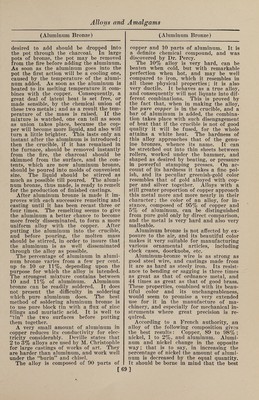
![(Fusibility of Alloys) (Table of Alloys) Bismuth . Cadmium . Copper ... Gold. Iron. Lead. Magnesium Manganese Mercury .. Degrees Cent. 268.3 320 1080.5 1061.7 1550-1600 330- 335 632.7 1800-1900 39.4 Nickel ..., Phosphorus Platinum . Silicon .. ., Silver .... Sulphur . . Tellurium . Tin., Zinc.. Degrees Cent. 1400-1450 44 1775 1100-1300 960.5 114.5 282 231.68 419 Table of Alloys The following is a table of the proportions of the various metals in the alloys most com¬ monly employed in the arts and manufactures. The term “parts” means parts by weight. The abbreviations are: Cu, copper; Zn, zinc; Sn, tin; Pb, lead; Sb, antimony; P, phosphorus; As, arsenic; Ni, nickel. Description. Cu. Zn. Sn. Pb. Sb. 1. Metal for frictional parts of locomotives (extremely hard). 87 5 8 • • 2. Bearings of carriages. 97 3 • • • • 3. Bearings of driving wheels, also for steam engine whistles, giving a clear sound.. 80 2 18 4. Steam engine whistles giving a deep sound 81 2 17 , , 5. Cross heads of connecting rods. 82 2 16 e • 6. Cylinders of pumps, valve boxes, and taps 88 2 10 , % 7. Eccentric collars. 84 2 14 • » 84 2 14 • • 8. Bearings of axles and trunnions; eccen- 85 2 13 • • trie collars. ] 84 7 9 • • 68 4 28 9. Pistons of locomotives. 88 9 3 # # 84 8.4 2.9 4.7 10. Axle boxes. 88 2 10 , , 11. Mathematical instruments, arms of balances 90 2 8 , , 12. Machinery, bearings, etc. 67 • « 14 19 13. Steam engine whistles. 30 , , 18 . . 2 14. Metal to withstand friction (Stephenson).. 79 5 8 8 15. Rivets . 64 24.6 3 9 16. Metal for coffins. 15 . . 40 45 17. Metal to withstand friction. 2 • s 72 . , 26 18. Cylinders of pumps. 7 72 21 • • • . 19. Metal for bearings of locomotives. 2 , . 90 , , 8 20. White brittle metal (for buttons, etc.). 10 6 20 • • 64 21. Imitation silver. 64 . . 3 . , * . 22. Pinchbeck . 5 1 . , , , . , 23. Tombac ... 16 1 1 • * , . 24. Red tombac. 10 1 • • • • . . 25. Specially adapted for bearings. 83 15.5 • • 1. 26. For bearings and valves. 83.25 7 9 • . 27. Electrotype “backing metal”. • • 4 91 5 28. Stereotype metal for paper process. • • • • 88 12 29. “ “ “ plaster process. • • • • 82 18 30. Bullet metal.- • • • • 92 31. Malleable brass plate. 67 33 • • 0.5 32. Pin wire. 67 33 0.5 0.5 33. Jemmapes brass. 64.6 33.7 0.2 1.5 34. Similor for gilding. 92.7 4.6 2.7 . . 35. Maillechort for rolling. 60 20 • • . . 36. “ first quality. 8 3 • • • • 37. White similor. 7 • • • . 38. For stopcock seats. . • 86 • • 14 39. “ “ plugs. • • 80 • • 20 40. For keys of flutes, etc.. • • 20 40 41 Tfard tin . 1 , , 0. 42. White tombac. 75 25 . • • • 43. Vogel’s alloy for polishing steel. 8 i 2 1 • • 44. Rompel’s anti-friction metal. 62 10 10 18 • • 45. Arguzoid, a tough alloy superior to brass.. 56 23 4 3.5 • • [67] P. As. Ni. 0.75 2 20 4 0.5 .. 13.5](https://iiif.wellcomecollection.org/image/b31361523_0081.jp2/full/800%2C/0/default.jpg)