The Scientific American cyclopedia of formulas : partly based upon the twenty-eighth edition of Scientific American cyclopedia of receipts, notes and queries 15,000 formulas / edited by Albert A. Hopkins.
- Albert A. Hopkins
- Date:
- 1910
Licence: Public Domain Mark
Credit: The Scientific American cyclopedia of formulas : partly based upon the twenty-eighth edition of Scientific American cyclopedia of receipts, notes and queries 15,000 formulas / edited by Albert A. Hopkins. Source: Wellcome Collection.
87/1096 page 73
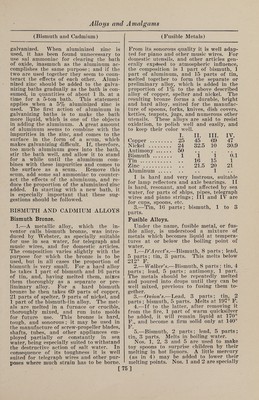
![(Aluminum and Silver) count of the cost of magnesium, they have not been widely adopted for com¬ mercial purposes. Manganese. Manganese is one of the best harden¬ ers of aluminum. Mercury. These metals unite with difficulty, but at the same time amalgams and alloys can be produced by uniting the two met¬ als. No useful results, however, have yet been shown from any of such alloys or combinations. Metalloids. Although all the metalloids and gase¬ ous elements, such as oxygen, nitrogen, sulphur, selenium, chlorine, iodine, bro¬ mine, fluorine, boron, silicon and carbon unite with aluminum with more or less ease under certain conditions, yet no use¬ ful result has been recorded as due to the combination of any of these elements with metallic aluminum. The union of the above metalloids in combination with aluminum results in alloys which, from a commercial standpoint, are undesirable in every way. The prevention of the oc¬ clusion of gaseous metalloids in molten aluminum, and the prevention of the union of carbon with the metal, are among the chief precautions to be ob¬ served in the metallurgy of aluminum. Molybdenum. Aluminum can be readily alloyed with molybdenum in the process, by placing the molybdenum oxide in the electrolytic bath with the oxide of aluminum. Molyb¬ denum acts as a hardener for aluminum, and forms alloys which will have special advantages for some work, as in the pro¬ duction of aluminum coins and medals. Nickel. 1. —This alloy, with from 2 to 5% of the combined alloying metals, is very sat¬ isfactory for rolling or hammering. By larger proportions, of 7 to 9%, a good casting alloy is produced. 2. —Two new alloys for jewelry consist of: (1) Nickel, 20 parts; with alumi¬ num 8 parts. (2) Nickel, 40 parts; sil¬ ver, 10 parts ; aluminum, 30 parts; tin, 20 parts. Silver. 1.—The addition of a few per cent, of silver to aluminum, to harden, whiten and strengthen the metal, gives a mate¬ rial especially adaptable for many fine (Aluminum and Uranium) instruments and tools, and for electrical apparatus, where the work upon the tool, and its convenience, are of more conse¬ quence than the increased price due to the addition of the silver. Silver lowers the melting point of aluminum and gives a metal susceptible of taking a good polish and making fine castings. 2.—Aluminum, 3 parts; silver, 1 part. This alloy is very easy to work. Tellurium. When tellurium is heated with alumi¬ num, the two combine with explosive vio¬ lence, forming a chocolate-colored, diffi¬ cultly fusible compound, which has the composition of Al2 Te3. It is hard and brittle, and can readily be ground to pow¬ der ; when exposed to moist air it is de¬ composed, and hydrogen telluride, with its fetid odor, is slowly evolved; when thrown into water it is rapidly decom¬ posed. Tin. 1. —Tin has been alloyed with alumi¬ num in proportions of from 1 to 15% of tin, giving added strength and rigidity to heavy castings, as well as sharpness of outline, with a decrease in the shrinkage of the metal. The alloys of aluminum and tin are rather brittle, however, and although small proportions of tin, in cer¬ tain casting alloys, have been advantage¬ ously used to decrease the shrinkage, on account of the comparative cost and brit¬ tleness of the tin alloys, they are not gen¬ erally used. 2. —Aluminum, 100 parts ; tin, 10 parts. 3. —Aluminum, 90% ; tin, 10%. 4. —Bourltonne's Aluminum Alloy—• Aluminum and tin, equal parts. This al¬ loy solders easily. Titanium. Titanium alloys of aluminum, although hard to manufacture uniformly homo¬ geneous, have greater spring and resili¬ ence than most other aluminum alloys. Alloys of titanium, chromium and copper, together with aluminum, give some of the hardest and toughest light alloys yet pro¬ duced. Tungsten. The alloys of aluminum and tungsten have been used to some extent for the past few years in Europe for rolled sheets and plates, under the trade name of “Wolframium.” Uranium. This alloy is an expensive one; and while uranium appears to be a good hard- [73]](https://iiif.wellcomecollection.org/image/b31361523_0087.jp2/full/800%2C/0/default.jpg)