The Scientific American cyclopedia of formulas : partly based upon the twenty-eighth edition of Scientific American cyclopedia of receipts, notes and queries 15,000 formulas / edited by Albert A. Hopkins.
- Albert A. Hopkins
- Date:
- 1910
Licence: Public Domain Mark
Credit: The Scientific American cyclopedia of formulas : partly based upon the twenty-eighth edition of Scientific American cyclopedia of receipts, notes and queries 15,000 formulas / edited by Albert A. Hopkins. Source: Wellcome Collection.
88/1096 page 74
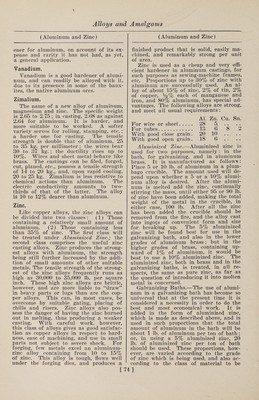
![(Aluminum and Zinc) ener for aluminum, on account of its ex¬ pense and rarity it has not had, as yet, a general application. Vanadium. Vanadium is a good hardener of alumi¬ num, and can readily be alloyed with it, due to its presence in some of the baux¬ ites, the native aluminum ores. Zimalium. The name of a new alloy of aluminum, magnesium and zinc. The specific weight is 2.65 to 2.75 ; in casting, 2.68 as against 2.64 for aluminum. It is harder, and more suitable to be worked. A softer variety serves for rolling, stamping, etc.; a harder one for casting. The tensile strength is double that of aluminum, 25 to 35 kg. per millimeter; the wires bear 30 to 37 kg. ; the ductility rises up to 10%. Wires and sheet metal behave like brass. The castings can be filed, forged, cut, planed, etc., possess a tensile strength of 14 to 20 kg., and, upon rapid cooling, 20 to 25 kg. Zimalium is less resistive to chemical actions than aluminum. The electric conductivity amounts to two- thirds of that of the latter. The alloy is 10 to 12% dearer than aluminum. Zinc. Like copper alloys, the zinc alloys can be divided into two classes: (1) Those containing a relatively small amount of aluminum. (2) Those containing less than 35% of zinc. The first class will be treated under Aluminized Zinc; the second class comprises the useful zinc casting alloys. Zinc produces the strong¬ est alloys with aluminum, the strength being still further increased by the addi¬ tion of small amounts of other suitable metals. The tensile strength of the strong¬ est of the zinc alloys frequently runs as high as 30,000 to 35,000 lb. per square inch. These high zinc alloys are brittle, however, and are more liable to “draw” in heavy parts or lugs than are the cop¬ per alloys. This can, in most cases, be overcome by suitable gating, placing of chills and risers. Zinc alloys also pos¬ sess the danger of having the zinc burned out in melting, thus producing a weaker casting. With careful work, however, this class of alloys givejs as good satisfac¬ tion as copper alloys in respect to hard¬ ness, ease of machining, and use in small parts not subject to severe shock. For forging, few metals excel an aluminum- zinc . alloy containing from 10 to 15% of zinc. This alloy is tough, flows well under the forging dies, and produces a (Aluminum and Zinc) finished product that is solid, easily ma¬ chined, and remarkably strong per unit of area. Zinc is used as a cheap and very effi¬ cient hardener in aluminum castings, for such purposes as sewing-machine frames, etc. Proportions up to 30% of zinc with aluminum are successfully used. An al¬ loy of about 15% of zinc, 2% of tin, 2% of copper, y2% each of manganese and iron, and 80% aluminum, has special ad¬ vantages. The following alloys are strong, and meet all usual requirements: Al. Zn. Cu. Sn. For wire or sheet. 28 5. For tubes. 13 6 8 2 With good close grain. 20 10 With good open grain .18 6 . . Aluminized Zinc.—Aluminized zinc is used for two purposes, namely: in the bath, for galvanizing, and in aluminum brass. It is manufactured as follows: Place 5 or 10 lb. of aluminum in a plum¬ bago crucible. The amount used will de¬ pend upon whether a 5 or a 10% alumi¬ num alloy is desired. After the alumi¬ num is melted add the zinc, continually stirring the mass, until either 95 or 90 lb. of zinc have been added, making the total weight of the metal in the crucible, in either case, 100 lb. After all the zinc has been added the crucible should be removed from the fire, and the alloy cast into ingots of convenient form and size for breaking up. The 5% aluminized zinc will be found best for use in the galvanizing bath, and also in the. lower grades of aluminum brass; but in the higher grades of brass, containing up¬ ward of 1% of aluminum, it would be best to use a 10% aluminized zinc.. The aluminized zinc, both in brass and in the galvanizing baths, is treated, in all re¬ spects, the same as pure zinc., as far as the question of introducing it into molten metal is concerned. Galvanizing Baths.—The use of alumi¬ num in a galvanizing bath has become so universal that at the present time it is considered a necessity in order to do the best and most economical work. It is added in the form of aluminized zinc, which is made as described above, and is used in such proportions that the total amount of aluminum in the bath will be about 1 lb. of aluminum per ton of bath ; or, in using a 5% aluminized zinc, 20 lb. of aluminized zinc per toil of bath should be used. These proportions, how¬ ever, are varied according to the grade of zinc which is being used, and also ac¬ cording to the class of material to be [74]](https://iiif.wellcomecollection.org/image/b31361523_0088.jp2/full/800%2C/0/default.jpg)