Household bacteriology for students in domestic sciences / by Estelle D. Buchanan ... and Robert Earle Buchanan.
- Buchanan, Estelle D. (Estelle Denis Fogel), 1876-
- Date:
- 1913
Licence: In copyright
Credit: Household bacteriology for students in domestic sciences / by Estelle D. Buchanan ... and Robert Earle Buchanan. Source: Wellcome Collection.
70/570 page 50
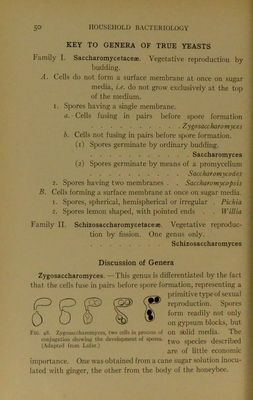
![KEY TO GENERA OF TRUE YEASTS j Family I. Saccharomycetaceae. Vegetative reproduction by i budding. j A. Cells do not form a surface membrane at once on sugar j media, i.e. do not grow exclusively at the top \ of the medium. j 1. Spores having a single membrane. a. Cells fusing in j)airs before spore formation Zygosaccharomyces b. Cells not fusing in pairs before spore formation. (1) Spores germinate by ordinary budding. Saccharomyces (2) Spores germinate by means of a promycelium Saccharomycodes 2. Spores having two membranes . . Saccharomycopsis B. Cells forming a surface membrane at once on sugar media. 1. Spores, spherical, hemispherical or irregular . Pichia ' 2. Spores lemon shaped, with pointed ends . . Willia Family II. Schizosaccharomycetaceae. Vegetative reproduc- tion by fission. One genus only. ' Schizosaccharomyces Discussion of Genera Zygosaccharomyces.—This genus is differentiated by the fact that the cells fuse in pairs before spore formation, representing a ])rimitive type of sexual iXi) reproduction. Spores form readily not only on gypsum blocks, but on solid media. The two species described are of little economic 0 Fig. 48. Zygosaccharomyces, two cells in process of conjugation showing the development of spores. (.Adapted from Lafar.) importance. One was obtained from a cane sugar solution inocu- lated with ginger, the other from the body of the honeybee.](https://iiif.wellcomecollection.org/image/b28089893_0070.jp2/full/800%2C/0/default.jpg)
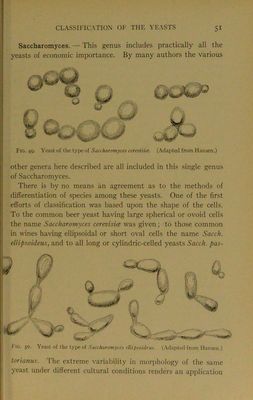
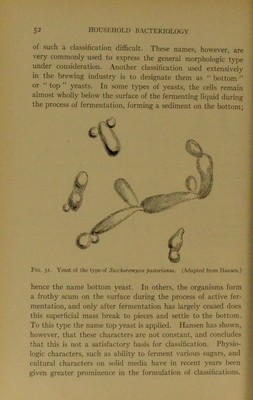
 No text description is available for this image
 No text description is available for this image
 No text description is available for this image