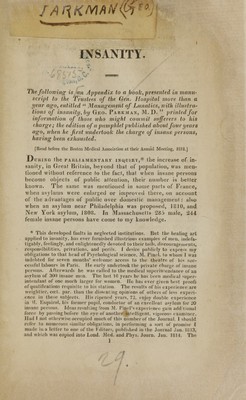
Insanity, the following is an appendix to a book, presented in manuscript to the trustees of the gen. hospital more than a year ago, entitled "Management of lunatics, with illustrations of insanity, by Geo. Parkman, M.D." : printed for the information of those who might commit sufferers to his charge.
- George Parkman
- Date:
- [1818]
Licence: Public Domain Mark
Credit: Insanity, the following is an appendix to a book, presented in manuscript to the trustees of the gen. hospital more than a year ago, entitled "Management of lunatics, with illustrations of insanity, by Geo. Parkman, M.D." : printed for the information of those who might commit sufferers to his charge. Source: Wellcome Collection.
Provider: This material has been provided by the National Library of Medicine (U.S.), through the Medical Heritage Library. The original may be consulted at the National Library of Medicine (U.S.)
5/22
![r/uiKMAtf<i< INSANITY. The following is an Appendix to a book, presented in manu- script to the Trustees of the Gen. Hospital more than a year ago, entitled Management of Lunatics, with illustra- tions of insanity, by Geo. Parkman, M. D. printed for information of those who might commit sufferers to his charge; the edition of a pamphlet published about four years ago, when he first undertook the charge of insane persons, having been exhausted. [Read before the Boston Medical Association at their Annual Meeting, 1818.] During the parliamentary inquiry,* the increase of in- sanity, in Great Britain, beyond that of population, was men- tioned without reference to the fact, that when insane persons become objects of public attention, their number is better known. The same was mentioned in some parts of Fiance, when asylums were enlarged or improved there, on account of the advantages of public over domestic management: also when an asylum near Philadelphia was proposed, 1810, and New York asylum, 1808. In Massachusetts 285 male, 244 female insane persons have come to my knowledge. * This developed faults in neglected institutions. But the healing art applied to insanity, has ever furnished illustrious examples of men, indefa- tigably, feelingly, and enlightenedly devoted to their toils, discouragements, responsibilities, privations, and perils. I desire publicly to express my obligations to that head of Psychological science, M. Find, to whom I was indebted for seven months' welcome access to the theatre of his suc- cessful labours in Paris. He early undertook the private charge of insane persons. Afterwards he was called to the medical superinfendance of an asylum of 300 insane men. The last 16 years he has been medical «uper- intendant of one much larger for women. He has ever given best proofs ofquali6cations requisite to his station. The results of his experience are weightier, ccet. par. than the dissenting opinions of others of less experi- ence in these subjects. His ripened years, 73, enjoy double experience in vT. Esquirol, his former pupil, conductor of an excellent asylum for 20 insane persons. Ideas resulting from M. Pinel's experience gain add tinnal force by passing before the eye of another intelligent, vigorous examiner. Had I not otherwise occupied much of this number of the Journal. I should refer to numerous similar obligations, in performing a sort of promise I made in a letter to one of the Editors, published in the Journal Jan. 1813, and which was copied into Lond. Med. and Phys. Journ. Jan. 1814, The](https://iiif.wellcomecollection.org/image/b21145714_0005.jp2/full/800%2C/0/default.jpg)