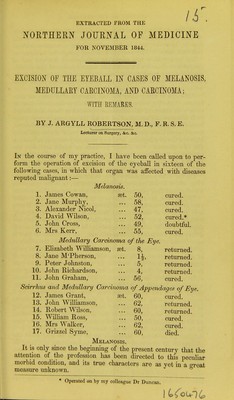
Excision of the eyeball in cases of melanosis, medullary carcinoma, and carcinoma : with remarks / by J. Argyll Robertson.
- Robertson, J. Argyll.
- Date:
- 1844
Licence: Public Domain Mark
Credit: Excision of the eyeball in cases of melanosis, medullary carcinoma, and carcinoma : with remarks / by J. Argyll Robertson. Source: Wellcome Collection.
Provider: This material has been provided by UCL Library Services. The original may be consulted at UCL (University College London)
6/18 page 4
![period the lens usually becomes opaque, but sometimes remains transparent, and the iris appears to be diminished in thickness, and perhaps altered in colour, and its pupillary margin is generally irregularly oval, the greater diameter being transverse. The pa- tient now complains of an uneasy fulness in the eye, accompanied by occasional attacks of pain and throbbing, and tortuous vessels are seen on the conjunctiva. As the tumour increases in bulk these symptoms become more severe, until interstitial absorption of the sclerotic takes place, allowing of the projection of the mass beyond the natural hmits of the eyeball, and thereby relieving this organ from distention. This absorption of the sclerotic usually occurs near the margin of the cornea, and between the tendons of the straight muscles where the sclerotic is thinnest and most readily yields. The projection is generally in the form of irregular nodules, as if constricted in certain points where some fibres of the sclerotic have not yielded to the same extent as others. At this stage melanosis is very apt to be mistaken for dropsi- cal effusion under the choroid, conjoined with amaurosis. In all the cases of this latter affection which I have seen, the iris was drawn behind the sclerotic in the direction of the protrusion, to such an extent in some instances as to be rendered invisible at that side of the eye—whereas I have not seen any such change occur in any case of melanosis. The pro- bable cause of this difference in regard to the iris is, that when the melanotic matter is deposited between the sclerotic and choroid, no traction will be applied to the latter membrane, whereas in dropsy within the choroid, that membrane will be bulged outwards and subjected to traction, and will drag along with it the corresponding portion of the iris; for the adhesion of the iris to the choroid being much stronger than to the ciHary ligament, the latter connexion gives way. This condition of the iris will, I beheve, prove a means of judging whether tumours or dropsies are internal or external to the choroid,—in the former the iris retaining its natural position, in the latter being drawn towards the protrusion. So similar are the appear- ances of melanosis and sub-choroid dropsy, owing to their same- ness of colour, that in two instances of the latter disease I saved eyes wliich had been doomed to excision. Any doubt as to the true nature of the disease may at once be set at rest by puncture. If it be dropsy, a little fluid will escape, and the sweUing imme- diately subside; if melanosis, a drop or two of black matter may ooze out, but with little or no change in the size of the projection. After the tumour has passed through the unyielding sclerotic by the process of interstitial absorption, it pushes before it the conjunctiva, which, from its texture and loose connexions to subjacent parts, readily yields, and affords it a covering. When it projects much beyond the eyelids, the secretion of the con- junctiva hardens upon its surface, giving it a horny coating of a yellow colour. [See Figs. 1 and 2.]](https://iiif.wellcomecollection.org/image/b21633514_0006.jp2/full/800%2C/0/default.jpg)