Licence: Public Domain Mark
Credit: [Collection of reprints]. Source: Wellcome Collection.
Provider: This material has been provided by the Augustus C. Long Health Sciences Library at Columbia University and Columbia University Libraries/Information Services, through the Medical Heritage Library. The original may be consulted at the the Augustus C. Long Health Sciences Library at Columbia University and Columbia University.
148/176 page 260
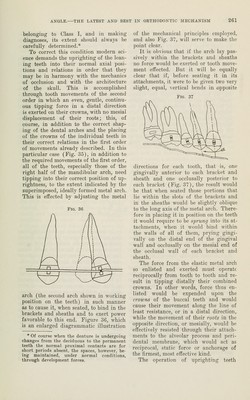
![SECOND OKDEE OF TOOTH MOVEMENTS We shall now consider the second order of tooth movements or the simultaneous tipping backward of all of the teeth on one or both sides of either or both dental arches, force for this purpose also being derived from the elasticity of the delicate metal arch already in position in the Fig. 35 brackets and other attachments and oper- ating at the same time for accomplish- ing the first order of movements. Figure 35 illustrates the use of the mechanism in a case Avhich requires such move- ments ; a complicated case, but yet a very common type of malocclusion, and one not caused by heredity, evolutionary changes,'^ faulty endocrins, faulty metabolism, unbalanced diet, or even Dental Cosmos, Vol. Ixxi, March 1929 an inferiority complex, but just by the common habit of frequently abnormally contracting the lips, with the usual re- sults : incisors bunched and overlapping, with more or less rotation; cuspids ro- tated; dental arches narrowed, their con- tinuity becoming more and more broken as the eruption of the teeth progressed. Also, an almost constant accompaniment of these conditions, frequently over- looked, is a leaning or tipping forward of the cuspids and of all of the buccal teeth, an inevitable result of the great weight or stress of occlusion falling on teeth bereft of their natural resistance to—^their natural balancing of—this stress. Normally, the muscular force from the lips, especially potent in each act of swallowing, prevents the drifting forward of the teeth and holds them in their normal upright axial positions. /This force is transmitted to the individ- ual teeth through their points of balance, or proximal contact points, from the in- cisors even to the third molars. But when a dental arch is broken through malrelations of the points of balance, the lips cannot exert normal influence and thus restrain mesial axial perversions of the teeth, and there must follow their tipping mesially, as well as an intensify- ing of the malrelations of their points of balance, as seen in Figs. ], 65 and 67.* It seems reasonable to believe that this abnormal axial leaning naturally follows more or less in all cases in which the arches are thus broken, especially in cases * The difference in the degree of mesial tip- ping of the teeth in the cases shown in Figs. 17 and .35 is easy to account for by the dif- ference in the form of lip habit of the two patients, the respective habits being the cause of the malocclusion in both instances.](https://iiif.wellcomecollection.org/image/b21229818_0148.jp2/full/800%2C/0/default.jpg)