Eight lectures on the signs of life from their electrical aspect / by Augustus D. Waller.
- Augustus Desiré Waller
- Date:
- 1903
Licence: Public Domain Mark
Credit: Eight lectures on the signs of life from their electrical aspect / by Augustus D. Waller. Source: Wellcome Collection.
Provider: This material has been provided by the Augustus C. Long Health Sciences Library at Columbia University and Columbia University Libraries/Information Services, through the Medical Heritage Library. The original may be consulted at the the Augustus C. Long Health Sciences Library at Columbia University and Columbia University.
63/192 page 51
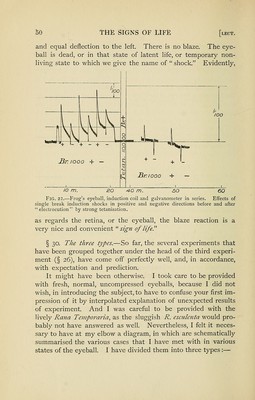
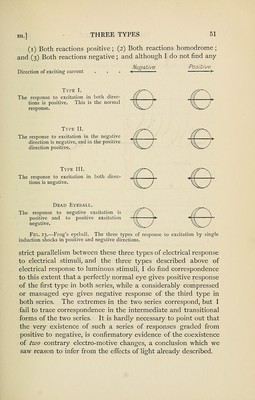
![m.] (i) Both reactions positive; (2) Both reactions homodrome ; and (3) Both reactions negative; and although I do not find any Direction of exciting current Negative Positive Type I. The response to excitation in both direc- tions is positive. This is the normal response. Type II. The response to excitation in the negative direction is negative, and in the positive direction positive. Type III. The response to excitation in both direc- tions is negative. Dead Eyeball. The response to negative excitation is positive and to positive excitation negative. Fig. 23.—Frog's eyeball. The three types of response to excitation by single induction shocks in positive and negative directions. strict paralleHsm between these three types of electrical response to electrical stimuli, and the three types described above of electrical response to luminous stimuli, I do find correspondence to this extent that a perfectly normal eye gives positive response of the first type in both series, while a considerably compressed or massaged eye gives negative response of the third type in both series. The extremes in the two series correspond, but I fail to trace correspondence in the intermediate and transitional forms of the two series. It is hardly necessary to point out that the very existence of such a series of responses graded from positive to negative, is confirmatory evidence of the coexistence of two contrary electro-motive changes, a conclusion which we saw reason to infer from the effects of light already described.](https://iiif.wellcomecollection.org/image/b21204767_0063.jp2/full/800%2C/0/default.jpg)

 No text description is available for this image
 No text description is available for this image
 No text description is available for this image