Eight lectures on the signs of life from their electrical aspect / by Augustus D. Waller.
- Augustus Desiré Waller
- Date:
- 1903
Licence: Public Domain Mark
Credit: Eight lectures on the signs of life from their electrical aspect / by Augustus D. Waller. Source: Wellcome Collection.
Provider: This material has been provided by the Augustus C. Long Health Sciences Library at Columbia University and Columbia University Libraries/Information Services, through the Medical Heritage Library. The original may be consulted at the the Augustus C. Long Health Sciences Library at Columbia University and Columbia University.
69/192 page 57
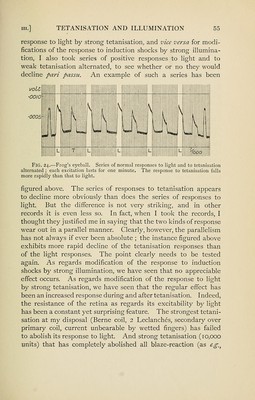
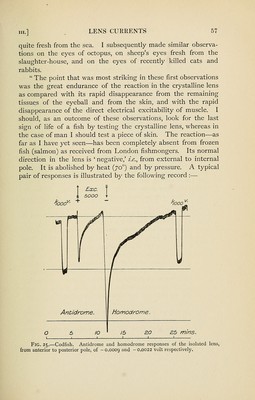
![!•] quite fresh from the sea. I subsequently made similar observa- tions on the eyes of octopus, on sheep's eyes fresh from the slaughter-house, and on the eyes of recently killed cats and rabbits. The point that was most striking in these first observations was the great endurance of the reaction in the crystalline lens as compared with its rapid disappearance from the remaining tissues of the eyeball and from the skin, and with the rapid disappearance of the direct electrical excitability of muscle. I should, as an outcome of these observations, look for the last sign of life of a fish by testing the crystalline lens, whereas in the case of man I should test a piece of skin. The reaction—as far as I have yet seen—has been completely absent from frozen fish (salmon) as received from London fishmongers. Its normal direction in the lens is ' negative,' i.e., from external to internal pole. It is abolished by heat (70°) and by pressure. A typical pair of responses is illustrated by the following record :— 25 mins. Fig. 25.—Codfish. Antidrome and homodrome responses of the isolated lens, from anterior to posterior pole, of -0.0009 and -0.0022 volt respectively.](https://iiif.wellcomecollection.org/image/b21204767_0069.jp2/full/800%2C/0/default.jpg)
 No text description is available for this image
 No text description is available for this image
 No text description is available for this image