On the blind, and institutions for the blind, in Europe : a letter to the president of the board of managers of the Pennsylvania Institution for the Instruction of the Blind / by Robley Dunglison.
- Robley Dunglison
- Date:
- 1854
Licence: Public Domain Mark
Credit: On the blind, and institutions for the blind, in Europe : a letter to the president of the board of managers of the Pennsylvania Institution for the Instruction of the Blind / by Robley Dunglison. Source: Wellcome Collection.
Provider: This material has been provided by the National Library of Medicine (U.S.), through the Medical Heritage Library. The original may be consulted at the National Library of Medicine (U.S.)
9/24
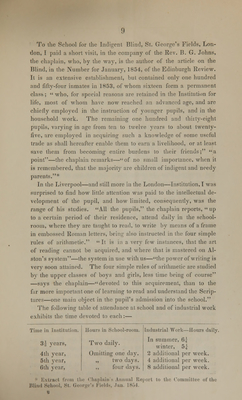
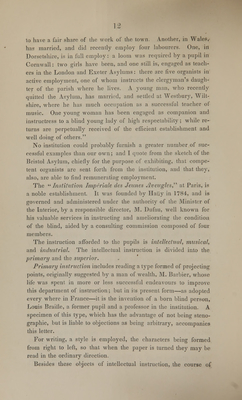
![To the School for the Indigent Blind, St. George's Fields, Lon- don, I paid a short visit, in the company of the Rev. B. G. Johns, the chaplain, who, by the way, is the author of the article on the Blind, in the Number for January, 1854, of the Edinburgh Review. It is an extensive establishment, but contained only one hundred and fifty-four inmates in 1853, of whom sixteen form a permanent class; who, for special reasons are retained in the Institution for life, most of whom have now reached an advanced age, and are chiefly employed in the instruction of younger pupils, and in the household work. The remaining one hundred and thirty-eight pupils, varying in age from ten to twelve years to about twenty- five, are employed in acquiring such a knowledge of some useful trade as shall hereafter enable them to earn a livelihood, or at least save them from becoming entire burdens to their friends; a point—the chaplain remarks—of no small importance, when it is remembered, that the majority are children of indigent and needy parents.* In the Liverpool—and still more in the London—Institution, I was surprised to find how little attention was paid to the intellectual de- velopment of the pupil, and how limited, consequently, was the range of his studies. All the pupils, the chaplain reports, up to a certain period of their residence, attend daily in the school- room, where they are taught to read, (o write by means of a frame in embossed Roman letters, being also instructed in the four simple rules of arithmetic. It is in a very few instances, that the art of reading cannot be acquired, and where that is mastered on Al- ston's system—the system in use with us—the power of writing is very soon attained. The four simple rules of arithmetic are studied by the upper classes of boys and girls, less time being of course —says the chaplain—devoted to this acquirement, than to the far more important one of learning to read and understand the Scrip- tures—one main object in the pupil's admission into the school. The following table of attendance at school and of industrial work exhibits the time devoted to each:— Time in Institution. Hours in School-room. Industrial Work—Hours daily 3| years, Two daily. In summer. 6] winter, 5^ 4th year, Omitting one day. 2 additional per week. 5th year, „ two days. 4 additional per week. 6th year, ., four days. 8 additional per week. Extract from the Chaplain - Annual Report to the Committee of the Blind School, St. George's Fields, Jan. L854.](https://iiif.wellcomecollection.org/image/b2111674x_0009.jp2/full/800%2C/0/default.jpg)

 No text description is available for this image
 No text description is available for this image
 No text description is available for this image