Census of England and Wales, 1921 : general report with appendices / [General Register Office].
- General Register Office Northern Ireland
- Date:
- 1927
Licence: Public Domain Mark
Credit: Census of England and Wales, 1921 : general report with appendices / [General Register Office]. Source: Wellcome Collection.
29/240 page 15
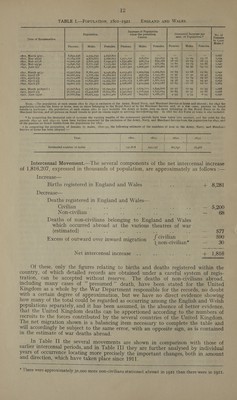
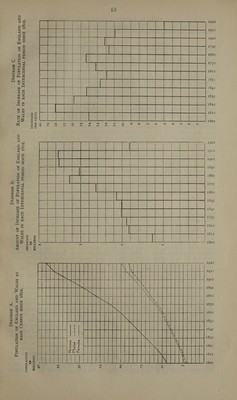
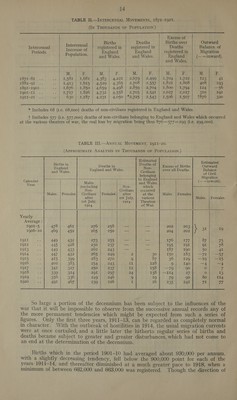
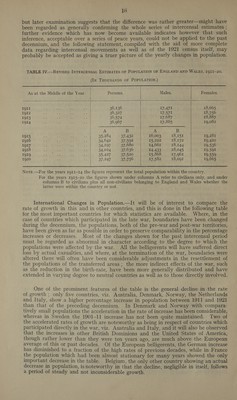
![the movement changed upon the cessation of the principal hostilities in 1918 and large increases were recorded after the middle of 1919, the actual amount of the increase within the intercensal period has not been nearly sufficient to compensate for the deficiencies of the war years. Deaths, on the other hand, if account be taken of those of non-civilians belonging to England and Wales which occurred overseas, showed no such decline between 1914 and 1918; the peace-time average of 507,000 registered in 1911-13 rose to between 600,000 and 700,000 in each of the years 1915-17, and probably reached 750,000 in 1918 owing to the /further imposition of the severe influenza mortality experienced towards the end of that year. After 1918 the death-rate, like the birth- rate, at once took a favourable turn, the numbers ultimately showing a notable reduction even in comparison with those of the years preceding the war. To the combined effect of diminished births and increased deaths resulting over the ten years in a natural increase of 2,436,000 (bringing all war deaths into account), as compared with 4,044,000 in the previous intercensal period, must be ascribed principally the exceptionally low increase in population now recorded. Migration, of course, contributes to the total movement, but, notwithstanding the restrictions placed on normal passenger traffic, the net population loss from this cause over the whole decennium did not exceed about 620,000, a figure which is only 119,000 in excess of the corresponding figure for the preceding intercensal period. It must be borne in mind that the migration figures of Tables II and III represent the balance between two much larger movements in opposite directions, and that a small change in either of the direct currents will involve a relatively much greater change in the net difference between the two; for this reason, and also from the fact that the movements are likely to be more readily responsive to changing social and economic conditions, the records of successive periods will tend to vary to a much greater degree than those of births and deaths. This is illustrated in the last columns of Table I] ; the 1911-21 figure for females is rather higher than any corresponding figure shown in the table, but for the two sexes taken together they are not out of character with their antecedents and are in no way indicative of,the abnormal movements of which they form the net result. For a knowledge of the migration of a period other than that beginning and ending with a census, recourse must be had to the returns collected by the Board of Trade. These have been extended and improved since 1911, but they do not afford the means of accurately determining the number of migrants from and to England and Wales as a separate unit. The migration figures shown in the final columns of Table III are therefore approximate ; they are based upon the Board of Trade Returns for the individual years, which have been modified to secure a general correspondence in the aggregate with the net intercensal figure deduced above. There appears to have been a considerable outward flow in the years 1911-13 which was reversed in 1914 and after a period of quietude again restored in 1919. The suddenness both of the reversal in 1914 and its later restoration is no doubt largely accounted for by the influx and repatriation of war refugees. Revision of Intercensal Estimates of Population.—A brief reference may be made here to the estimates of population in respect of years of the past intercensal period given by the Registrar General in his successive Annual Reports for those years. The estimates were prepared on such data, much of it incomplete or imperfect, as were at hand at the time the estimates were made, and the whole intercensal series falls naturally to be revised in the light of the results of the recent census figures. A description of the methods used in the estimation of each year’s population is given in the report for the particular year, and no more need be said here than to point out that after 1913 any assumptions based upon peace-time continuity in the .several factors contributing to population changes became untenable, and that with the inevitable reticence which had to be observed in respect of the large and unusual movements taking place continually between _ this country and other parts of the world, it became extraordinarily difficult to identify the numbers within the country at any given point of time. The close correspondence of the final estimate with the 1921 enumeration—the Preliminary Report of the Census stated that the estimate was in excess by about 1 per 1,000,](https://iiif.wellcomecollection.org/image/b32183197_0029.jp2/full/800%2C/0/default.jpg)