Census of England and Wales, 1921 : general report with appendices / [General Register Office].
- General Register Office Northern Ireland
- Date:
- 1927
Licence: Public Domain Mark
Credit: Census of England and Wales, 1921 : general report with appendices / [General Register Office]. Source: Wellcome Collection.
48/240 page 32
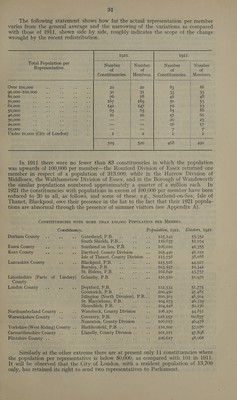
![CONSTITUENCIES WITH LESS THAN 50,000 POPULATION PER MEMBER. Constituency. . Population, 1921. Electors, 1921. Cheshire County .. * .. Eddisbury, County Division AF 48,034 22,272 Cumberland County - .. Northern, County Division ‘3 46,736 21,545 Penrith and Cockermouth, Count 44,794 21,460 ; Division. ’ Dorsetshire County 55 .. Northern, County Division os 48,666 24,372 Western, County Division ix 48,044 23,602 Durham County .. es .. Barnard Castle, County Division .. 48,012 20,455 London County... <a .. City of London (including the Inner 13,709 44,083 and Middle Temples), P.B. Holborn, P.B. fe cae vs 43,192 26,449 Suffolk, West County as .. Sudbury, County Division ses 49,457 26,034 Worcestershire County .. > euacworcester, .y.aenmmes E - 48,833 23,801 Merionethshire County... ry: ss By nA = i 45,087 21,384 In the last two columns of Table 17 (General Tables Volume) comparison is made between the male and female electorate and the corresponding populations above the ages of 21 and 30 respectively, the age limits which govern the franchise quali-- fication under the Act. For the whole country the electorate forms 95-3 per cent. of the male population and 79-9 per cent. of the females in the said age classes, leaving approximately 5 per cent. and 20 per cent. as the proportions disfranchised respectively. In the case of males, however, the electoral register, representing voting strength, rather overstates the number of individuals entitled to vote, owing to the possession by the same person of residence qualifications and business premises qualifications in different constituencies, and resulting therefore in a certain amount of plural representation. The business premises votes number about 2 per cent. of the whole, and if these be excluded the proportion of men over 21 years of age who are disfranchised may in consequence be regarded as nearer 7 per cent. than the 5 per cent. suggested above. From its nature, the business premises vote does not affect all constituencies alike ; it may be expected to occur with greater frequency in commercial and business centres, and examples of this will be found in the table, rather more frequently in borough constituencies, where the proportion of electorate to total male population over 2] is in excess of 100 per cent., the outstanding case being the City of London, where there are more than 5 male electors for each resident male over 21. In the case of women the conditions are somewhat different. The bulk of the women on the register are married women entitled to a vote in respect of their husband’s occupation of premises, so that the proportion of electorate varies rather more in the case of women than it does in the case of men, because of the additional variable introduced in the proportion of women married in the several areas. In only three constituencies, the City of London and two other London divisions, is the female electorate in excess of the corresponding population. 4. Ecclesiastical Areas. England, the Channel Islands and the Isle of Man are for ecclesiastical purposes divided into two Provinces—those of Canterbury and York—containing between them 38 dioceses, each of which is subdivided into a number of eccle- siastical parishes and extra-parochial places. Current population statistics of each of these areas, together with comparative figures for 1911, have been published in a separate census volume devoted to ecclesiastical areas, and in a foreword to that volume will be found an outline of the foundation and development of their territorial organisation up to the present time. __ A point of importance to be observed in connection with the 1921 enumeration is that since the date of the preceding census (1911) considerable change has taken place both in the machinery of government and in the territorial arrangements of the Church. In the first place, by the Welsh Church Act, 1914, the Church in Wales and Monmouthshire was disestablished. Disestablishment was suspended during the period of the Great War in pursuance of the Suspensory Act, 1914, but finally took effect, under the provisions of an amending Act (Welsh Church (Temporalities) Act, 1919) on the 3lst March, 1920. Meanwhile, under the provisions of Section 9 (1) of the first-mentioned Act, the inhabitants of each of the border. parishes (i.e. those](https://iiif.wellcomecollection.org/image/b32183197_0048.jp2/full/800%2C/0/default.jpg)