Medical clinics of the Hospital Necker, or, Researches and observations on the nature, treatment, and physical causes of diseases. Tr. from the French.
- Isidore Bricheteau
- Date:
- 1837
Licence: Public Domain Mark
Credit: Medical clinics of the Hospital Necker, or, Researches and observations on the nature, treatment, and physical causes of diseases. Tr. from the French. Source: Wellcome Collection.
Provider: This material has been provided by the University of Massachusetts Medical School, Lamar Soutter Library, through the Medical Heritage Library. The original may be consulted at the Lamar Soutter Library at the University of Massachusetts Medical School.
30/434 page 14
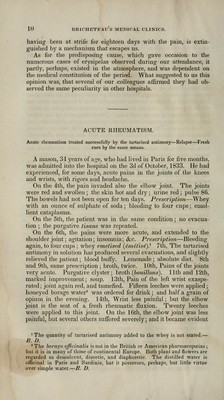
![On the 13th the patient—seeing- that her disease increased daily, or at least that to a rheumatic fluxion on one point there succeeded one more violent on another, so that she was unable to use her limbs—had herself conveyed to the Hospital Necker. 14th. She passed a very bad night, without sleep ; face flushed ; pulse not very frequent (8U); heat of skin moderate; joints of the wrists, knees, and elbows painful, red, swollen and bent; the slight- est motion gave intense pain; no symptom of gastric irritation. Eight days having elapsed since the invasion of the attack; tiie pulse being neither very hard nor very frequent; the mouth clammy; and the tongue covered with a mucous coat; it was considered that we might dispense with a preliminary blood-letting, and administer the tartarised antimony from the first. A muci- laginous mixture was consequently given with eight grains of tartarised antimony and half an ounce of syrup of poppies, to be administered by spoonfuls every half hour. For drink, borage water: (absolute diet). 15th. The mixture has occasioned vomiting, and three evacua- tions from the bowels. Slight improvement in the symptoms. Same mixture, with ten grains tartarised antimony, and an ounce of syrup of poppies: (diet). 16th. The tolerance is completely established, and the patient has had no evacuation. The improvement is progressive ; the pulse much less frequent, and the motions more free. Same mixture, with twelve grains of tartarised antimony. 17th. The tolerance continues : the patient has passed a good night: the pains are considerably diminished: a copious diapho- resis has broken out. Same prescription as last evening. Broth, twice [deux houillons). 18th. The patient says she is cured, and wishes to take no more of the mixture, which has caused some nausea. She can rise and aid in making her bed. The swelling and redness have disap- peared from the joints; she asks vociterously for food. A light soup was allowed her; but the mixture with eight grains of the tartarised antimony was continued. I9th. She vomited several times, and had some evacuations from the bowels. The emetised mixture was now discontinued, and she might be considered cured. She continued, in fact, to improve gradually; and at the end of a month left the hospital, feeling nothing more of the rheumatism. This case is chiefly deserving attention from the promptitude and completeness of the cure, which was effected in less than a week. The tartarised antimony has, moreover, the honour of it. There was no relapse during the ten days which the patient passed in the hospital after the termination of the treatment. It is worthy of remark, that the tartarised antimony produced an evacuant effect as soon as the rheumatism ceased to exist; doubtless because then controstimulation was no longer practicable; or, if you choose, because there was no longer any relationship between the morbid entity and the action of the medicine [?] We are of opinion that](https://iiif.wellcomecollection.org/image/b21197532_0030.jp2/full/800%2C/0/default.jpg)



 No text description is available for this image
 No text description is available for this image
 No text description is available for this image