The treatment of fractures : with notes upon a few common dislocations.
- Charles Locke Scudder
- Date:
- 1900-11
Licence: Public Domain Mark
Credit: The treatment of fractures : with notes upon a few common dislocations. Source: Wellcome Collection.
Provider: This material has been provided by the Augustus C. Long Health Sciences Library at Columbia University and Columbia University Libraries/Information Services, through the Medical Heritage Library. The original may be consulted at the the Augustus C. Long Health Sciences Library at Columbia University and Columbia University.
101/722 (page 93)
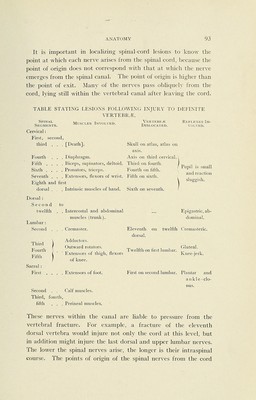
![It is important in localizing spinal-cord lesions to know the point at which each nerve arises from the spinal cord, because the point of origin does not correspond with that at which the nerve emerges from the spinal canal. The point of origin is higher than the point of exit. Many of the nerves pass obliquely from the cord, lying still within the vertebral canal after leaving the cord. TABLE STATING LESIONS FOLLOWING INJURY TO DEFINITE VERTEBRAE. Spinal Segments. Muscles Involved. Vertebra Dislocated. Reflexes In- volved. Cervical: First, second, third . . . [Death]. Skull on atlas, atlas on axis. Fourth . . . Diaphragm. Axis on third cervical Fifth .... Biceps, supinators, deltoid. Third on fourth. Sixth .... Pronators, triceps. Fourth on fifth. Seventh . . . Extensors, flexors of wrist. Fifth on sixth. Eighth and first dorsal . . . Intrinsic muscles of hand. Sixth on seventh. Pupil is small and reaction sluggish. Dorsal : Secon d to twelfth . . Intercostal and abdominal Lumbar : muscles (trunk). Second . . Cremaster. Third . Fourth Fiftli 1 Adductors. Outward rotators. Extensors of thigh, flexors of knee. Sacral : First . . . Extensors of foot. Second Calf muscles. Third, foi irth. fifth . . Perineal muscles. Epigastric, ab- dominal. Eleventh on twelfth Cremasteric, dorsal. _, ,r, ,- , , Gluteal. 1 weiith on first lumbar. . Knee-jerk. First on second lumbar. Plantar and ankle -clo- nus. These nerves within the canal are liable to pressure from the vertebral fracture. For example, a fracture of the eleventh dorsal vertebra would injure not only the cord at this level, but in addition might injure the last dorsal and upper lumbar nerves. The lower the spinal nerves arise, the longer is their intraspinal course. The points of origin of the spinal nerves from the cord](https://iiif.wellcomecollection.org/image/b21207707_0101.jp2/full/800%2C/0/default.jpg)