Volume 1
The universal herbal; or, botanical, medical, and agricultural dictionary. Containing an account of all the known plants in the world, arranged according to the Linnean system ... With the best methods of propagation, and the most recent agricultural improvements / By Thomas Green.
- Green, Thomas, active 1816-1820
- Date:
- [1824]
Licence: Public Domain Mark
Credit: The universal herbal; or, botanical, medical, and agricultural dictionary. Containing an account of all the known plants in the world, arranged according to the Linnean system ... With the best methods of propagation, and the most recent agricultural improvements / By Thomas Green. Source: Wellcome Collection.
32/1006 page 14
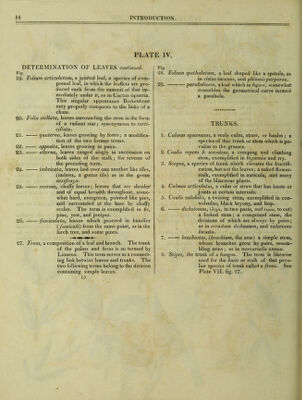
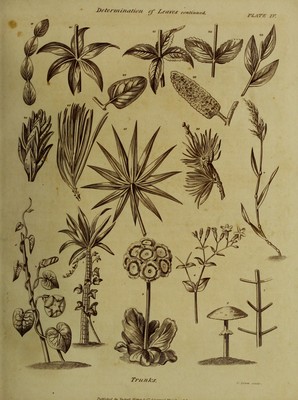
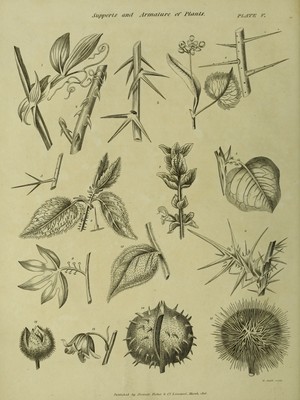
![PLATE IV. DETERMINATION OE LEAVES continued. Fig. ]Q. Folium articulatum, a jointed leaf, a species of com- pound leaf, in which the leaflets are pro- duced each from the summit of that im- mediately under it, as in Cactus opuntia. This singular appearance Berkenhout very properly compares to the links of a chain. 20. Folia stellata, leaves surrounding the stem in the form of a radiant star; synonymous to verti- cillata. 21. quaterna, leaves growing by fours; a modifica- tion of the two former terms. 22. opposita, leaves growing in pairs. 23. alterna, leaves ranged singly in succession on both sides of the stalk; the reverse of the preceding term. 24. imbricata, leaves laid over one another like tiles, (imbrex, a gutter tile) as in the genus saxifraga. 25. acerosa, chaffy leaves ; leaves that are slender* and of equal breadth throughout, some- what hard, evergreen, pointed like pins, and surrounded at the base by chaffy scales. The term is exemplified in fir, pine, yew, and juniper. 20. fasciculata, leaves which proceed in bundles (fasciculi) from the same point, as in the larch tree, and some pines. 27. Frons, a composition of a leaf and branch. The trunk of the palms and ferns is so termed by Linneus. This term serves as a connect- ing link betwixt leaves and trunks. The two following terms belong to the division containing simple leaves. 15 Fig. 28. Folium spathulatum, a leaf shaped like a spatula, as in cist us incanus, and phlomis purpurea. 29. parabo/icum, a leaf which in figuie, somewhat resembles the geometrical curve termed a parabola. TRUNKS. 1. Culmus squamosus, a scaly culm, straw, or haulm ; a species of that trunk or stem which is pe- culiar to the grasses. 2. Caulis repens & scandens, a creeping and climbing stem, exemplified in bignonia and ivy. 3. Scapus, a species of trunk w hich elevates the fructifi- cation, but not the leaves; a naked flower- stalk, exemplified in auricula, and many of the liliaceous plants. 4. Culmus articulatus, a culm or straw that has knots or joints at certain intervals. 5. Caulis volubilis, a twining stem, exemplified in con- volvulus, black bryony, and hop. 6. dic/iotomus, in two parts, and tepm, to cut) a foiked stem; a compound stem, the divisions of which are always by pairs; as in cerastum dichomum, and Valeriana locusta. 7. brachiatus, (brachium, the arm) a simple stem, whose branches grow by pairs, resem- bling arms ; as in mercuria/is annua. S. Stipes, the trunk of a fungus. The term is likewise used for the basis or stalk of that pecu- liar species of trunk called a frons. See Plate VII. fig. 27.](https://iiif.wellcomecollection.org/image/b22006783_0001_0032.jp2/full/800%2C/0/default.jpg)