Volume 1
The universal herbal; or, botanical, medical, and agricultural dictionary. Containing an account of all the known plants in the world, arranged according to the Linnean system ... With the best methods of propagation, and the most recent agricultural improvements / By Thomas Green.
- Green, Thomas, active 1816-1820
- Date:
- [1824]
Licence: Public Domain Mark
Credit: The universal herbal; or, botanical, medical, and agricultural dictionary. Containing an account of all the known plants in the world, arranged according to the Linnean system ... With the best methods of propagation, and the most recent agricultural improvements / By Thomas Green. Source: Wellcome Collection.
38/1006 page 16
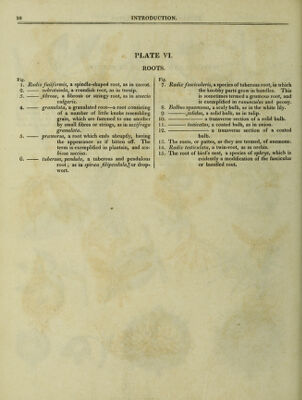
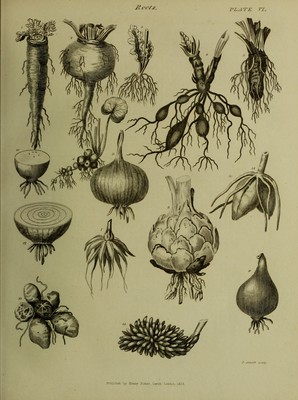
![01 so ROOTS. Fi<y 1. Radix fusiformis, a spindle-shaped root, as in carrot. subrotunda, a roundish root, as in turnip. fibrosa, a fibrous or stringy root, as in senecio vulgaris. 4. granulata, a granulated root—a root consisting of a number of little knobs resembling grain, which are fastened to one another by small fibres or strings, as in saxifraga granulata. 5. pramorsa, a root which ends abruptly, having the appearance as if bitten off. The term is exemplified in plantain, and sca- biosa succisa. G. tuberosa, pendula, a tuberous and pendulous root; as in spiraea filipendula,] or drop-r wort. r 7. Radix fascicularis, a species of tuberous root, in which the knobby parts grow in bundles. This is sometimes termed a grumous root, and is exemplified in ranunculus and peony. 8. JBulbus squamosus, a scaly bulb, as in the white lily. 9 ,solidus, a solid bulb, as in tulip. 10. a transverse section of a solid bulb. 11. tunicatus, a coated bulb, as in onion. 12. a transverse section of a coated bulb. 13. The roots, or pattes, as they are termed, of anemone. 14. Radix testiculata, a twin-root, as m orchis. 13. The root of bird’s nest, a species of opbrys, which is evidently a modification of the fascicular or bundled root,](https://iiif.wellcomecollection.org/image/b22006783_0001_0038.jp2/full/800%2C/0/default.jpg)