Practical and pathological researches on the various forms of paralysis.
- Edward Meryon
- Date:
- 1864
Licence: Public Domain Mark
Credit: Practical and pathological researches on the various forms of paralysis. Source: Wellcome Collection.
Provider: This material has been provided by UCL Library Services. The original may be consulted at UCL (University College London)
17/266 page 5
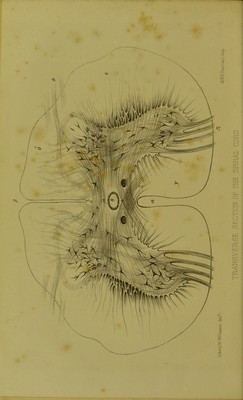
![These antero-posterior nerve-fibres, therefore, connect together several posterior roots of sensitive nerves; the posterior with the anterior cornua; the posterior columns with the lateral and anterior; one half of the spinal cord with the other; and, finally, the posterior nerve-roots with the anterior.* The laterO'timisverse fibres (/x) are arranged in loose bands, disposed more horizontally, and pass from one side of the grey substance to the other. Those behind the spinal canal diverge , on each side into the anterior and posterior cornua, and, from them, into the lateral and posterior columns. Some pass from one posterior nerve-root to its fellows on the opposite side; whilst others, in front of the spinal canal, connect the anterior nerve- roots in a similar manner. A few may be traced from the anterior roots into the lateral columns of the opposite side. These latere-transverse fibres, therefore, constitute the trans- verse commissure, and establish a communication between the opposite sides of the spinal cord on the same vertical plane. The experiments of Dr. Brown-Sequard have proved that the decussation of the nerves of sensation takes place in the spinal cord : hence it is probable that these latero-transverse fibres are the conductors of the impressions of sensation from one side of the body to the opposite side of the spinal cord.f There are besides, in the grey substance, numerous longitudinal fibres, which are chiefly collected together in the so-called substantia gelatinosa {v). These longitudinal fibres are inti- mately connected with the posterior nerve-roots and with the latero-transverse fibres [marginal fibres of Van der Kolk (o)], which surround the posterior cornua. The bundles of these longitudinal fibres are thicker at the lumbar and cervical dilatations of the cord; therefore it is very probable that they are not continued individually as far as the brain ; but, as Van der Kolk has suggested, that they may con- * In these connecting fibres may we not have the links which virtually make the afferent and efferent nerves continuous? the sensory nerve being changed in its function through the grey substance into the efferent nerve which excites the muscles to reflex action. t In Stiiling's experiments on the spinal cord, it was found that when division of that organ was made along the median plane, a stimulus applied to one leg caused reflex contractions of that leg only, and none of the other. The power of transmitting organic changes from one side of the cord to the other was destroyed by the section of the commissure.](https://iiif.wellcomecollection.org/image/b21272505_0021.jp2/full/800%2C/0/default.jpg)
 No text description is available for this image
 No text description is available for this image
 No text description is available for this image