On improving the condition of the insane. By an increased inspection of private asylums / by Henry Munro.
- Date:
- 1851
Licence: Public Domain Mark
Credit: On improving the condition of the insane. By an increased inspection of private asylums / by Henry Munro. Source: Wellcome Collection.
Provider: This material has been provided by the Royal College of Physicians of Edinburgh. The original may be consulted at the Royal College of Physicians of Edinburgh.
12/24 page 4
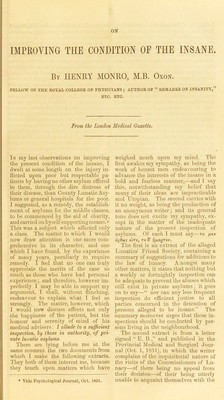
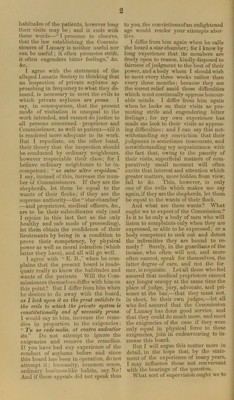
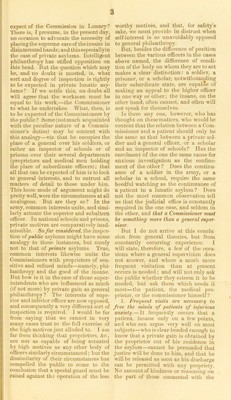
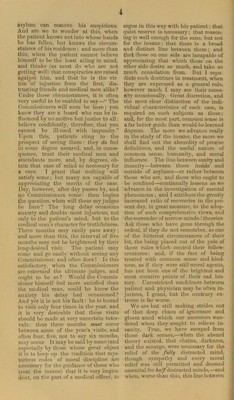
![asylum can remove bis suspicions. And are we to wonder at this, when the patient knows not into wliose hands he has fallen, but knows the circum- stances of his residence; and more than this, when the patient cannot believe himself to be the least ailing in mind, and thinks (as most do who arc not getting well ) that conspiracies are raised against him, and that he is the vie tim of injustice from the fii’st, dis- trusting friends and medical men alike ? Under these circumstances, it is often very useful to be enabled to say—“ The Commissioners will soon he here ; you know they are a hoard who can he in- fluenced by no motive hut justice to all: believe confidently, therefore, that you cannot he ill-used with impunity.” Ujion this, patients cling to the prospect of seeing them: they do feel in some degree assured, and, in conse- quence, trust their medical men and attendants more, and, by degrees, ob- tain that ease of mind so necessary for a cure. I grant that nothing will satisfy some; hut many are capable of a]ipreciating the merits of the case. Day, however, after day passes by, and no Commissionere come; then begins the question, when will these my judges be here? The long delay occasions anxiety and doubts most injurious, not only to the patient’s mind, but to the medical man’s character for truthfulness. Three mouths may easily pass away; and more than this, tlie interval of live months may not be brightened by their long-desired visit. Tlie patient may come and go easily without seeing any Commissioner, and often does! Is this satisfactory, wlien tlie Commissionei's arc esteemed the ultimate judges, and ought to be so? Would the Commis- sioner himself feel more satisfied than the medical man, could ho know the anxiety his delay had occasioned? And yet it is not his fault; he is bound to visit only four times in the year, and it is very desirable that these visits should bo made at very uncertain inter- vals; thus three montlis must occur between some of the year’s visits, and often four, five, not to say six months, may occur. It may be said by some (and especially by those whose great object it is to keep up the tradition that mys- terious codes of moral discipline are necessary for the guidance of those who treat the insane) that it is very impru- dent, on the part of a medical olficer, to ar^ie in this way with his patient; that quiet reserve is necessary; that reason- ing is well enough for the sane, but not for the insane; that there is a broad and distinct line between them; and that those on one side are incapable of appreciating that which those on the other side desire so much, and take so much consolation from. But I repu diate such doctrines in treatment, when they are expressed as a general rule, however much I may see their neces- sity occasionally. Great discretion, and the most clear distinction of the indi- vidual characteristics of each case, is required on such subjects as these; and, for the most part, common sense is a far better guide than would-be learned dogmas. Tlie more we advance really in the study of the insane, the more we shall find out the absurdity of precise definitions, and the useful nature of common sense, humanity, and moral influence. The line between sanity and insanity—between those inside and outside of asylums—or rather between those who are, and those who ought to be confined—continually lessens as we advance in the investigation of mental phenomena; and I attribute the gi-catly increased ratio of recoveries in the pre- sent day, in great measure, to the adop- tion of such comprehensive views, and the surrender of narrow-minded theories Ask those who have gone tlirough the ordeal, if they do not i-emembcr, as one i of the bitterest circumstances of their ' lot, the being placed out of the pale of ; those rules which control their fellow- ] creatures: and, if tlie fact of being j treated with common sense and kind- ness, as if they were still moral agents, ' has not been one of the brightest and ! most curative jioints of their sad his- j tory. Unrestricted confidence between j ])atient and physician may be often in- | jurious, I grant, but the contrary ex- | treme is far worse. We are but still making strides out ! of that deep chaos of ignorance and gloom amid which our ancestors wan- dered when they sought to relieve in- sanity. I’rue, we have escaped from those dark scenes,—when the absurd theory existed, that chains, darkness, and the scourge, were necessary for the relief of the fully distracted mind, though sympathy and every moral relief was still permitted and deemed essential for Aa/f distracted minds,—and when, worse than this, this line between](https://iiif.wellcomecollection.org/image/b2195138x_0012.jp2/full/800%2C/0/default.jpg)

 No text description is available for this image
 No text description is available for this image
 No text description is available for this image