On section of the cornea as a preliminary operation ; Needle-hooks in secondary cataract operations / by J.F. Streatfeild.
- Streatfeild, John Fremlyn, 1828-1886.
- Date:
- 1872
Licence: Public Domain Mark
Credit: On section of the cornea as a preliminary operation ; Needle-hooks in secondary cataract operations / by J.F. Streatfeild. Source: Wellcome Collection.
Provider: This material has been provided by The Royal College of Surgeons of England. The original may be consulted at The Royal College of Surgeons of England.
11/16 page 9
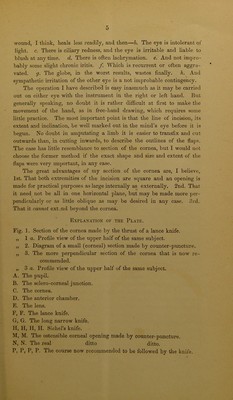
![The iris is much displaced and drawn backwards, out of its natural position, perhaps also it is in some degree compressed. The eye has a very ugly, unnatural appearance, and, as I have said, the final result of the case is incompatible with good vision. The results I have been describing are no doubt the worst, but I have been led to fear any considerable displacements of the vitreous humour in the ordinary operations, and Avhen the vitreous body has not been thus permanently locked in the aqueous chambers and has receded, the risk of its not receding has been incurred, and much dragging force in the backward direction has, at any rate, been exerted on the circumferential parts at the time of the operation, by which an inflammation might have been excited. [The object of the secondary operations for cataract is, I presume, to gain a sufficiently large central aperture in the opaque membrane, and to do this with as little disturbance of the neighbouring parts as may be. I do not often myself like to attempt the removal of these membranous opacities altogether in any way. As to the time of operating, I believe that if .the pupil can be well dilated with atropine, the operation should be done as soon as all appearance of redness in the ciliary region has finally disappeared. For these membranous expansions, at all events if there has been inflammatory mischief, become more and more tough and hard to tear by age, so that the operation should not be very long deferred. But nevertheless if there has been iritis, and especially if there are posterior synechias which cannot be detached by atropine, and prevent the dilatation of the pupil, I think, for fear of a consequent recurrence of iritis, the operation must be deferred for a month or more after all redness has disappeared in the eye.] The use of two needles at once, acting and counteracting for and against each other, was originally Mr. Bowman’s improvement, and was suggested by him twenty years ago. About three yeai’s ago (see the “ Ophthalmic Hospital Iieports,” vol. vi. pp. 209-213) Dr. AgneAv and Dr. Noyes of New York suggested further improvements. The former of these gentlemen (loc. cit.) makes two opposite openings in the corneal margin, one after the other, and the broad needle in one of the openings is advanced so as to penetrate the membranous septum, and held in this position. Then a small hook is entered at the opposite opening in the cornea and through the hole made in the septum, and then, with the broad- needle as a point of resistance, the hook is made to tear an opening. Dr. Noyes (loc. cit.) uses two hooks introduced at opposite sides by openings previously made in the margin of the cornea, by puncture and counter- puncture, with a long narrow knife, which is also made to penetrate the](https://iiif.wellcomecollection.org/image/b22451833_0011.jp2/full/800%2C/0/default.jpg)


 No text description is available for this image
 No text description is available for this image
 No text description is available for this image