A guide to the fossil invertebrate animals in the Department of geology and palaeontology in the British museum (Natural history) ... / With 7 plates and 96 textfigures.
- British Museum (Natural History). Department of Geology
- Date:
- 1911
Licence: In copyright
Credit: A guide to the fossil invertebrate animals in the Department of geology and palaeontology in the British museum (Natural history) ... / With 7 plates and 96 textfigures. Source: Wellcome Collection.
152/218 page 126
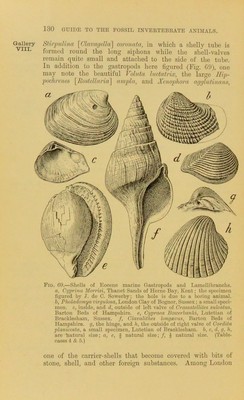
![VIII. 120 GUIDE TO THE FOSSIL INVEETEBRATE ANIMALS. have endured with little change from the .Silurian Epoch to the ]n’esent day. 1^ • LAMELLIBRANCHIAj of which the oyster and cockle are examples, usually have complicated gills (l)ranchiae) formed of many lamellae or plates; the foot is rarely used for crawling, hut is gener.dly wedge-shaped, whence they are also called PELECYPODA (hatchet-foot). Tliese features are naturally associated with a sedentary habit of life and with the suppression of the head-region. The shell is not deposited by a visceral hump, hut by two flaps of the mantle, placed on the right and left sides; hence it consists of two valves, which are joined along one edge by a ligament and generally a hinge, and can be closed by powerful muscles (adductors). The lamellibranchs are confined to the water, and most arc mai’ine. Some, like the oyster, aie fixed ; most burrow in mud or sand, and a few l)ore into wood or rock. This Class, as a v\’hole, presents a somewhat uniform structure, and it can hardly be said that any of the numerous attempts to divide it into Orders has met with general acceptance. Therefore we shall only indicate some of the chief variations that can be seen in the shell. These are; (1) the adductor muscle-scars, whether two equal, two unequal, or only one ; (2) the outline of the mantle- attachment (Fig. 68, 2), whether simple or indented by a sinus due to certain muscles that work tubular extensions of the mantle called siphons (but the absence of a sinus does not imply the absence of siphons); (3) perfect or deficient symmetry of the shell-valves ; (4) shell-structure, whether porcellanous or nacreous; (5) the arrangement of the ligament; (6) the hinge (Fig. 69, (j), whether plain or toothed, ami the varying numbers and development of the hinge-teeth. A few ill-preserved shells, apparently of simple Lamelli- branchs, have been found in the Cambrian rocks of AVales, Thuringia, and North America. In Ordovician rocks thev are still rare, but in Silurian times a score of families existed, mostly with thin shells of simple type. The Devonian saw the beginning of brackish and fresh-water lamellibranchs ; these increased in Carboniferous times, when also appeared Allorisma, the first form known to have a retractile siphon. With the Trias many of the older genera disappeared and new families came in, followed by others in the Jurassic period, when also Trigonia arose and soon flourished in numbers (Plate V.). Among Cretaceous lamelli-](https://iiif.wellcomecollection.org/image/b24863841_0152.jp2/full/800%2C/0/default.jpg)