A guide to the fossil invertebrate animals in the Department of geology and palaeontology in the British museum (Natural history) ... / With 7 plates and 96 textfigures.
- British Museum (Natural History). Department of Geology
- Date:
- 1911
Licence: In copyright
Credit: A guide to the fossil invertebrate animals in the Department of geology and palaeontology in the British museum (Natural history) ... / With 7 plates and 96 textfigures. Source: Wellcome Collection.
153/218 page 127
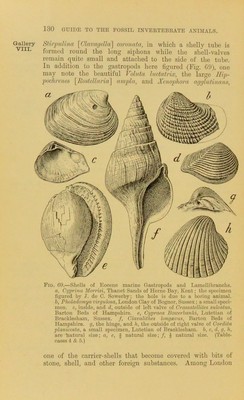
![branchs the Iludistae are remarkable and characteristic. The early Tertiary fossils are evidence of a gradual change to present conditions, botli in the character of the inolluscan fauna and its eventual distribution in the same provinces as are at present recognised. V. CEPHALOPODA (Head-foot), of which the Nautilus and cuttle-fish are examples. These are exhibited in Gallery VII. We shall therefore leave them for the present, and confine our attention to Gallery VIII., which contains fossil shells of only the first four Classes, viz.:— AMPHINEURA, GASTROPODA, SCAPHOPODA, LAMELLIBRANCHIA. Tt will be most convenient to start with the British specimens. Beginning at the main entrance to the Gallery, and following the numerical order of the Table-cases, these are arranged under the larger stratigraphical divisions, with the newest first. Post-Pliocene. The marine forms are separated from the non-marine, and are arranged under geographical districts in the following order: S. England, Selsea, &c.; S.E. England, including Norfolk; N.E. England, chiefly Yorkshire; W. England, Gloppa, near Oswestry; Wales, Moel Tryfaen; Ireland, the Wexford gravels and Belfast; Scotland, Clyde series; E. Scotland, chiefly Hyer’s Burn and Golspie; W. Scotland, including the Lewis. Some of these date from the Glacial period, others are later, as indicated on the label in each instance. They come from raised beaches, glacial drift, and other deposits, and are often found far above present sea-level, as much as 1350 feet at jMoel Tryfaen, 1120 feet at Gloppa, and 1200 feet at Calbeck Castle, near Dublin. Some writers have supposed that they were carried to these heights by moving ice. Most of the shells belong to species still existing, and they are as a rule characteristic of northern seas, but southern forms are sometimes associated with them. In the following list of the more important species, the letters N, S, and E respectively denote the Northern, Southern, and Extinct forms :—Gastropoda: Bittium reticu- lattim (S), Borcotrcrphoii YTrophoii] clathratum (N), Littorina littorca (N), Ncjotitnca antiqua (N), Tricolia \^I^kasianella\ pulla (S), Tritonofusus Lcclcenhiji (E), Turritdla communis (N). Lamellibranchia: Acila \^Nucula\ Col)holdiae QL), Area lactea (S), Callista [ Vcnus\ cliionc (S), Cerastodervia \Cardium\ Gallery VIII. Gallery VIII. Wall-cases 19. Table-cases 1-16. Centre- cases Al- A3 and A7. Table-cases 1 & 2.](https://iiif.wellcomecollection.org/image/b24863841_0153.jp2/full/800%2C/0/default.jpg)