A guide to the fossil invertebrate animals in the Department of geology and palaeontology in the British museum (Natural history) ... / With 7 plates and 96 textfigures.
- British Museum (Natural History). Department of Geology
- Date:
- 1911
Licence: In copyright
Credit: A guide to the fossil invertebrate animals in the Department of geology and palaeontology in the British museum (Natural history) ... / With 7 plates and 96 textfigures. Source: Wellcome Collection.
156/218 page 130
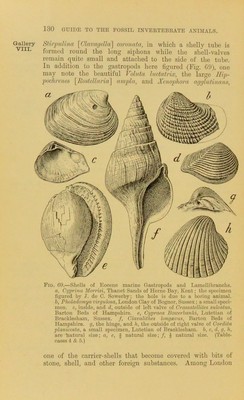
![Gallery Slirpulina \Clava<jclld\ corona fa, iu which a slielly tube is formed round the long siphons while the shell-valves remain quite small and attached to the side of the tube. In addition to the gastropods here figured (Fig. G9), one may note the beautiful Voluta Inctatrix, the large JLvp- 2)ochre)ies [liostcllaria'] mnp>la, and Xenophora arpjlutinans, Fig. G9.—Shells of Eocene marine Gastropods and Lamellibranchs. a, Cyprina Morrisi, Thanet Sands of Herne Bay, Kent; the specimen figured by J. de C. Sowerby; the bole is due to a boring animal. h, Plioladomya virgulosa, London Clay of Bognor, Sussex; a small speci- men. c, inside, and d, outside of left valve of Crassatelliies sulcatus, Barton Beds of Hampshire, e, Cypraea Bowerhanki, Lutetian of Brackle.sbam, Sussex. /, Glavalithes longxvii.t, Barton Beds of Hampshire, g, the hinge, and h, the outside of right valve of Gardita planicosta, a small specimen, Lutetian of Braoklesham. b, c, d, g, h, are natural size; a, e, Sf natural size; /, J natural size. (Table- cases 4 & 5.) one of the carrier-shells that become covered with bits of stone, shell, and other foreign substances. Among London](https://iiif.wellcomecollection.org/image/b24863841_0156.jp2/full/800%2C/0/default.jpg)