A guide to the fossil invertebrate animals in the Department of geology and palaeontology in the British museum (Natural history) ... / With 7 plates and 96 textfigures.
- British Museum (Natural History). Department of Geology
- Date:
- 1911
Licence: In copyright
Credit: A guide to the fossil invertebrate animals in the Department of geology and palaeontology in the British museum (Natural history) ... / With 7 plates and 96 textfigures. Source: Wellcome Collection.
177/218 page 149
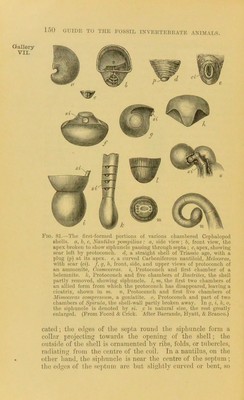
![MOLLUSCA—C]-:rHAL0r01)A. this mode of growth (Fig. 80 b). The shrinkage appears to have been greater from the first, and thus the septa stretch across the conical shell, dividing it into a series of chambers, and leaving only a narrow neck-tube in which there are no sheaths. The part of the shell-cavity in front of the last- formed septum is called the body-chamber, and in it was the main mass of the animal. From the visceral hump, how- ever, proceeded the fleshy siphuncle, passing through each septum to the ape.v of the shell. The line along which the septum is attached to the shell-wall is called a suture, and in these simple forms passes regularly all roiind the shell. There are numbers of straight shells of this simple type, but those that are the most completely known may be divided into two groups by the presence or absence of a small, more or less globular, initial chamber. This, which is generally separated from the next chamber by a slight constriction, is called the protoconch (first shell) and believed to be the shell of the embryonic cephalopod. It is well seen in some specimens of Bactrites (Fig. 81 1c). Often this protoconch seems to have been lost in the adult, and in its place is seen only a scar or cicatrix denoting its former presence (Fig 81, c, c, m). At an early period in the history of the cephalopod race the shell began to curve, and this curvature increased until the shell was coiled on itself. Such a coiled shell was far more manageable than the long shell of an Orthoceras, and was less liable to damage. And so it is found that the long straight shells gradually die out and give place to coiled shells. Now, just as there were two types of straight shells, so were there two of coiled shells: one with a protoconch, as may be seen in models of early goniatites (Fig. 81 n) ; the other without a protoconch, as shown by the model of Nautilus (Fig. 81 a-c). Further examination of the shells of these two types reveals other differences. The early coiled shells with a protocouch are long, narrow, smooth, with septa usually far apart, and with a long deep body- chamber (Fig. 81 n). Those without a protoconch are short, broad, often with a longitudinal ornament, with septa relatively close together, and with a shallow body-chamber (Fig. 81 a). In later forms of these two types other differences appear, such as will be realised by comparing an ammonite (which is one of the former series) with a Nautilus (lig. 82). Generally speaking the siphuncle of an ammonite is close to the outside of the coiled shell; the edges of the septa are folded, so that the sutures are coinj)!!- Gallery VII. Table-case 1.](https://iiif.wellcomecollection.org/image/b24863841_0177.jp2/full/800%2C/0/default.jpg)