A guide to the fossil invertebrate animals in the Department of geology and palaeontology in the British museum (Natural history) ... / With 7 plates and 96 textfigures.
- British Museum (Natural History). Department of Geology
- Date:
- 1911
Licence: In copyright
Credit: A guide to the fossil invertebrate animals in the Department of geology and palaeontology in the British museum (Natural history) ... / With 7 plates and 96 textfigures. Source: Wellcome Collection.
197/218 page 167
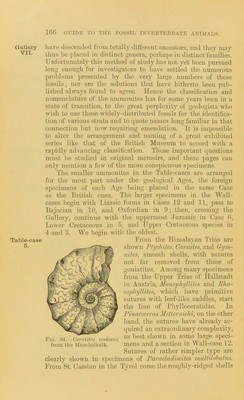
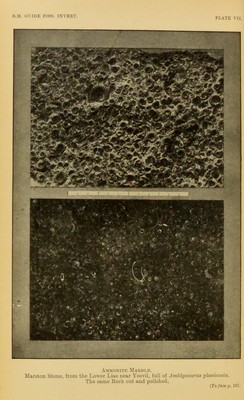
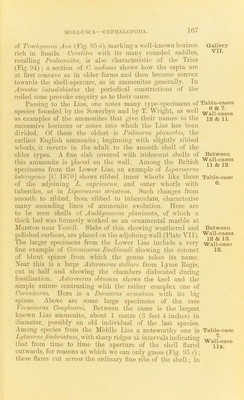
![of J.'mc/i.i/ccms yion (Fig. marking a well-known horizon rich in fossils. Cemfites with its many rounded saddles, recalling Frolecanitcs, is also characteristic of the Trias (Fig. 94); a section of C. nodosus shows how the septa are at first concave as in older forms and then become convex towards the shell-aperture, as in ammonites generally. In Arccstes intuslahiatus the periodical constrictions of the coiled cone provoke enquiry as to their cause. Passing to the Lias, one notes many type-specimens of species founded by the Sowerbys and by T. Wright, as well as examples of the ammonites that give their names to the successive horizons or zones into which the Lias has been divided. Of these the oldest is Psiloccras planorhis, the earliest l^nglish ammonite; beginning with slightly ribbed wliorls, it reverts in the adult to the smooth shell of the older types. A fine slab covered with iridescent shells of this ammonite is placed on the wall. Among the British specimens from the Lower Lias, an example of Liparoccras hetcrorjcnes [C 1870] shows ribbed inner whorls like those of the adjoining L. capricormi, and outer whorls with tubercles, as in Liparoccras striatum. Such changes from smooth to ribbed, from ribbed to tuberculate, characterise many ascending lines of ammonite evolution. Llero are to be seen' shells of Amhlycoccms plaaicosta, of which a thick bed was formerly worked as an ornamental marble at Marstun near Yeovil. Slabs of this, showing weathered and polished surfaces, are placed on the adjoining wall (Plate Vll). The larger specimens from the Lower Lias include a very fine example of Coroiiiccras Bucldandi showing the coronet of blunt spines from which the genus takes its name. Xear this is a large Astcroceras stellare from Lyme Eegis, cut in half and showing the chambers dislocated during fossilisation. Astcroceras ohtusum shows the keel and the simple suture contrasting with the rather complex one of Coroniceras. Here is a Deroccras arniatum with its big spines. Above are some large specimens of the rare Vermiceras Conyhearei. Betw'een the cases is the largest known Lias ammonite, about 1 metre (3 feet 4 inches) in diameter, possibly an old individual of the last species. Among species from the Middle Lias a noteworthy one is Lytoccras Jimbriatum, wdth sharp ridges at intervals indicating that from time to time the aperture of the shell flared outwards, for reasons at which we can only guess (Fig. 95 c) ; these flares cut across the ordinary fine ribs of the sliell; in Gallery VII. Table-eases 6 & 7. Wall-cases 12 & 11. Between W all-cases 11 & 12. Table-case 6. Between Wall-cases 12 & 13. Wall-case 12. Table-case 7. W all-case llB.](https://iiif.wellcomecollection.org/image/b24863841_0197.jp2/full/800%2C/0/default.jpg)