Contributions to the history of the phosphorus-bases / by Augustus William Hofmann.
- August Wilhelm von Hofmann
- Date:
- 1861
Licence: Public Domain Mark
Credit: Contributions to the history of the phosphorus-bases / by Augustus William Hofmann. Source: Wellcome Collection.
Provider: This material has been provided by King’s College London. The original may be consulted at King’s College London.
121/136 page 115
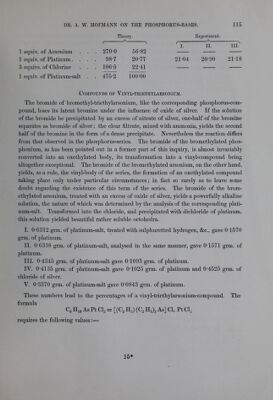
![1 equiv. of Arsonium 1 equiv. of Platinum . . 3 equivs. of Chlorine 1 equiv. of Platinum-salt Theory. Experiment. A ( 270-0 56-82 f I. II. III.' 98-7 106-5 475-2 20-77 22-41 100-00 21-04 20-90 21-18 Compounds of Vinyl-triethylarsonium. The bromide of bromethyl-triethylarsonium, like the corresponding phosphorus-com- pound, loses its latent bromine under the influence of oxide of silver. If the solution of the bromide be precipitated by an excess of nitrate of silver, one-half of the bromine separates as bromide of silver; the clear filtrate, mixed with ammonia, yields the second half of the bromine in the form of a dense precipitate. Nevertheless the reaction differs from that observed in the phosphorus-series. The bromide of the bromethylated phos- phonium, as has been pointed out in a former part of this inquiry, is almost invariably converted into an oxethylated body, its transformation into a vinyl-compound being- altogether exceptional. The bromide of the bromethylated arsonium, on the other hand, yields, as a rule, the vinyl-body of the series, the formation of an oxethylated compound taking place only under particular circumstances; in fact so rarely as to leave some doubt regarding the existence of this term of the series. The bromide of the brom- ethylated arsonium, treated with an excess of oxide of silver, yields a powerfully alkaline solution, the nature of which was determined by the analysis of the corresponding plati- num-salt. Transformed into the chloride, and precipitated with dichloride of platinum, this solution yielded beautiful rather soluble octohedra. I. 0-6312 grm. of platinum-salt, treated with sulphuretted hydrogen, &c., gave 0-1570 grm. of platinum. II. 0-6338 grm. of platinum-salt, analysed in the same manner, gave 0-1571 grm. of platinum. III. 0-4345 grm. of platinum-salt gave 0*1093 grm. of platinum. IV. 0-4135 grm. of platinum-salt gave 0-1025 grm. of platinum and 0-4525 grm. of chloride of silver. V. 0*3370 grm. of platinum-salt gave 0-0843 grm. of platinum. These numbers lead to the percentages of a vinyl-triethylarsonium-compound. The formula C8 H18 As Pt Cl3 = [(C2 H3) (C2 H5)3 As] Cl, Pt Cl, requires the following values:— 15*](https://iiif.wellcomecollection.org/image/b21309024_0121.jp2/full/800%2C/0/default.jpg)