Contributions to the history of the phosphorus-bases / by Augustus William Hofmann.
- August Wilhelm von Hofmann
- Date:
- 1861
Licence: Public Domain Mark
Credit: Contributions to the history of the phosphorus-bases / by Augustus William Hofmann. Source: Wellcome Collection.
Provider: This material has been provided by King’s College London. The original may be consulted at King’s College London.
126/136 page 120
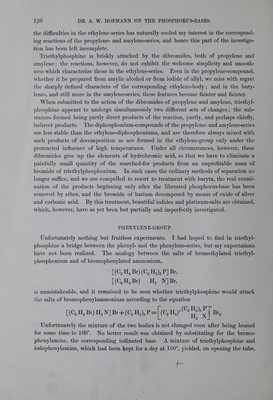
![the difficulties in the ethylene series has naturally cooled my interest in the correspond- ing reactions of the propylene- and amylene-series, and hence this part of the investiga- tion has been left incomplete. Triethylphosphine is briskly attacked by the dibromides, both of propylene and amylene; the reactions, however, do not exhibit the welcome simplicity and smooth- ness which characterize those in the ethylene-series. Even in the propylene-compound, whether it be prepared from amylic alcohol or from iodide of allyl, we miss with regret the sharply defined characters of the corresponding ethylene-body; and in the buty- lene-, and still more in the amylene-series, these features become fainter and fainter. When submitted to the action of the dibromides of propylene and amylene, triethyl- phosphine appears to undergo simultaneously two different sets of changes; the sub- stances formed being partly direct products of the reaction, partly, and perhaps chiefly, indirect products. The diphosphonium-compounds of the propylene- and amylene-series are less stable than the ethylene-diphosphoniums, and are therefore always mixed with such products of decomposition as are formed in the ethylene-group only under the protracted influence of high temperatures. Under all circumstances, however, these dibromides give up the elements of hydrobromic acid, so that we have to eliminate a painfully small quantity of the searched-for products from an unprofitable mass of bromide of triethylphosplionium. In such cases the ordinary methods of separation no longer suffice, and we are compelled to resort to treatment with baryta, the real exami- nation of the products beginning only after the liberated phosphorus-base has been removed by ether, and the bromide of barium decomposed by means of oxide of silver and carbonic acid. By this treatment, beautiful iodides and platinum-salts are obtained, which, however, have as yet been but partially and imperfectly investigated. PHENYLENE-GEOUP. Unfortunately nothing but fruitless experiments. I had hoped to find in triethyl- phosphine a bridge between the phenyl- and the phenylene-series, but my expectations have not been realized. The analogy between the salts of bromethylated triethyl- phosphonium and of bromophenylated ammonium, [(C2 H4 Br) (C2 H5)3 P] Br, [(C6 H4 Br) H3 N] Br, is unmistakeable, and it remained to be seen whether triethylphosphine would attack the salts of bromophenylammonium according to the equation [(C6H4Br)H3N]Br + (C2H5)3P = (C6H4) „(c2h5)3p7' Ho N Br, Unfortunately the mixture of the two bodies is not changed even after being heated for some time to 160°. No better result was obtained by substituting for the bromo- phenylamine, the corresponding iodinated base. A mixture of triethylphosphine and iodophenylamine, which had been kept for a day at 100°, yielded, on opening the tube, 4-](https://iiif.wellcomecollection.org/image/b21309024_0126.jp2/full/800%2C/0/default.jpg)