Contributions to the history of the phosphorus-bases / by Augustus William Hofmann.
- August Wilhelm von Hofmann
- Date:
- 1861
Licence: Public Domain Mark
Credit: Contributions to the history of the phosphorus-bases / by Augustus William Hofmann. Source: Wellcome Collection.
Provider: This material has been provided by King’s College London. The original may be consulted at King’s College London.
127/136 page 121
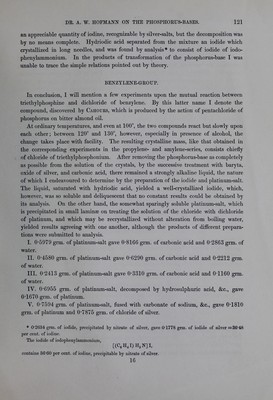
![an appreciable quantity of iodine, recognizable by silver-salts, but the decomposition was by no means complete. Hydriodic acid separated from the mixture an iodide which crystallized in long needles, and was found by analysis* to consist of iodide of iodo- phenylammonium. In the products of transformation of the phosphorus-base I was unable to trace the simple relations pointed out by theory. BENZYLENE-GROUP. In conclusion, I will mention a few experiments upon the mutual reaction between triethylphosphine and dichloride of benzylene. By this latter name I denote the compound, discovered by Cahours, which is produced by the action of pentachloride of phosphorus on bitter almond oil. At ordinary temperatures, and even at 100°, the two compounds react but slowly upon each other; between 120° and 130°, however, especially in presence of alcohol, the change takes place with facility. The resulting crystalline mass, like that obtained in the corresponding experiments in the propylene- and amylene-series, consists chiefly of chloride of triethylphosphonium. After removing the phosphorus-base as completely as possible from the solution of the crystals, by the successive treatment with baryta, oxide of silver, and carbonic acid, there remained a strongly alkaline liquid, the nature of which I endeavoured to determine by the preparation of the iodide and platinum-salt. The liquid, saturated with hydriodic acid, yielded a well-crystallized iodide, which, however, was so soluble and deliquescent that no constant results could be obtained by its analysis. On the other hand, the somewhat sparingly soluble platinum-salt, which is precipitated in small laminae on treating the solution of the chloride with dichloride of platinum, and which may be recrystallized without alteration from boiling water, yielded results agreeing with one another, although the products of different prepara- tions were submitted to analysis. I. 0-5979 grm. of platinum-salt gave 0-8166 grm. of carbonic acid and 0-2863 grm. of water. II. 0-4580 grm. of platinum-salt gave 0-6290 grm. of carbonic acid and 0-2212 grm. of water. III. 0*2413 grm. of platinum-salt gave 0-3310 grm. of carbonic acid and 0-1160 grm. of water. IV. 0-6955 grm. of platinum-salt, decomposed by hydrosulphuric acid, &c., gave 0*1670 grm. of platinum. V. 0-7594 grm. of platinum-salt, fused with carbonate of sodium, &c., gave 0-1810 grm. of platinum and 0-7875 grm. of chloride of silver. * 02G34 grm. of iodide, precipitated by nitrate of silver, gave 0-1778 grm. of iodide of silver =36-48 per cent, of iodine. The iodide of iodophenylammonium, [(C6 H41) H3N] I, contains 36-60 per cent, of iodine, precipitable by nitrate of silver. 16](https://iiif.wellcomecollection.org/image/b21309024_0127.jp2/full/800%2C/0/default.jpg)