Contributions to the history of the phosphorus-bases / by Augustus William Hofmann.
- August Wilhelm von Hofmann
- Date:
- 1861
Licence: Public Domain Mark
Credit: Contributions to the history of the phosphorus-bases / by Augustus William Hofmann. Source: Wellcome Collection.
Provider: This material has been provided by King’s College London. The original may be consulted at King’s College London.
131/136 page 125
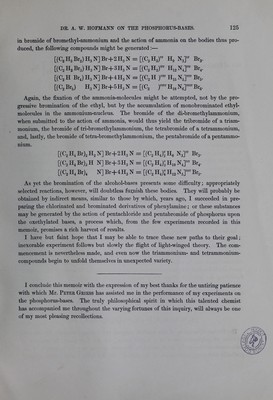
![in bromide of bromethyl-ammonium and the action of ammonia on the bodies thus pro- duced, the following compounds might be generated:— [(C2 H3 Br2) H3 N] Br+2 H3 N = [(C2 HJ H9 NJ Br3. [(C2H2Br3)H3N]Br+3H3N = [(C2H2) H12N4] Br4. [(C2H Br4)H3N]Br+4H3N = [(C2H H15NJ Br5. [(C2 Br5) H3 N] Br+5H3 N = [(C2 ) H18 NJ' Br6. Again, the fixation of the ammonia-molecules might be attempted, not by the pro- gressive bromination of the ethyl, but by the accumulation of monobrominated ethyl- molecules in the ammonium-nucleus. The bromide of the di-bromethylammonium, when submitted to the action of ammonia, would thus yield the tribromide of a triam- monium, the bromide of tri-bromethylammonium, the tetrabromide of a tetrammonium, and, lastly, the bromide of tetra-bromethylammonium, the pentabromide of a pentammo- nium. [(C2H4Br)2H2N]Br+2H3N = [(C2H4)H8 NJ Br3. [(C2H4Br)3H N]Br+3H3N = [(C2 H4) H10 NJ Br4. [(C2 H4 Br)4 N] Br+4H3 N = [(C2 H4) H12 NJ Br5. As yet the bromination of the alcohol-bases presents some difficulty; appropriately selected reactions, however, will doubtless fui^iish these bodies. They will probably be obtained by indirect means, similar to those by which, years ago, I succeeded in pre- paring the chlorinated and brominated derivatives of phenylamine; or these substances may be generated by the action of pentachloride and pentabromide of phosphorus upon the oxethylated bases, a process which, from the few experiments recorded in this memoir, promises a rich harvest of results. I have but faint hope that I may be able to trace these new paths to their goal; inexorable experiment follows but slowly the flight of light-winged theory. The com- mencement is nevertheless made, and even now the triammonium- and tetrammonium- compounds begin to unfold themselves in unexpected variety. I conclude this memoir with the expression of my best thanks for the untiring patience with which Mr. Petek Griess has assisted me in the performance of my experiments on the phosphorus-bases. The truly philosophical spirit in which this talented chemist has accompanied me throughout the varying fortunes of this inquiry, will always be one of my most pleasing recollections.](https://iiif.wellcomecollection.org/image/b21309024_0131.jp2/full/800%2C/0/default.jpg)