Licence: Public Domain Mark
Credit: The works of John Hunter. Source: Wellcome Collection.
Provider: This material has been provided by the Royal College of Physicians of Edinburgh. The original may be consulted at the Royal College of Physicians of Edinburgh.
74/512
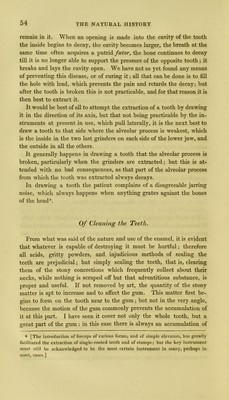
![remain in it. When an opening is made into the cavity of the tooth the inside begins to decay, the cavity becomes larger, the breath at the same time often acquires a putrid fcetor, the bone continues to decay till it is no longer able to support the pressure of the opposite tooth; it breaks and lays the cavity open. We have not as yet found any means of preventing this disease, or of curing it; all that can be done is to fill the hole with lead, which prevents the pain and retards the decay; but after the tooth is broken this is not practicable, and for that reason it is then best to extract it. It would be best of all to attempt the extraction of a tooth by drawing it in the direction of its axis, but that not being practicable by the in- struments at present in use, which pull laterally, it is the next best to draw a tooth to that side where the alveolar process is weakest, which is the inside in the two last grinders on each side of the lower jaw, and the outside in all the others. It generally happens in drawing a tooth that the alveolar process is broken, particularly when the grinders are extracted; but this is at- tended with no bad consequences, as that part of the alveolar process from which the tooth was extracted always decays. In drawing a tooth the patient complains of a disagreeable jarring noise, which always happens when anything grates against the bones of the head8. Of Cleaning the Teeth. From what was said of the nature and use of the enamel, it is evident that whatever is capable of destroying it must be hurtful; therefore all acids, gritty powders, and injudicious methods of scaling the teeth are prejudicial; but simply scaling the teeth, that is, clearing them of the stony concretions which frequently collect about their necks, while nothing is scraped off but that adventitious substance, is proper and useful. If not removed by art, the quantity of the stony matter is apt to increase and to affect the gum. This matter first be- gins to form on the tooth near to the gum; but not in the very angle, because the motion of the gum commonly prevents the accumulation of it at this part. I have seen it cover not only the whole tooth, but a great part of the gum: in this case there is always an accumulation of a [The introduction of forceps of various forms, and of simple elevators, has greatly facilitated the extraction of single-rooted teeth and of stumps; but the key instrument must still be acknowledged to be the most certain instrument in many, perhaps in most, cases.]](https://iiif.wellcomecollection.org/image/b21996635_0002_0074.jp2/full/800%2C/0/default.jpg)



 No text description is available for this image
 No text description is available for this image
 No text description is available for this image