Licence: Public Domain Mark
Credit: The works of John Hunter. Source: Wellcome Collection.
Provider: This material has been provided by the Royal College of Physicians of Edinburgh. The original may be consulted at the Royal College of Physicians of Edinburgh.
83/512
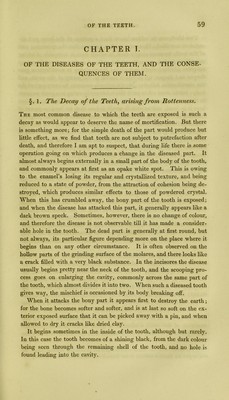
![Symptoms of Inflammation. Few or no symptoms are produced by this disease besides the above appearances till the cavity of the tooth is exposed : however, it often happens that a tenderness, or a soreness upon touch, or other external influences, takes place long before; but when the cavity is exposed, then pain and other symptoms often begin, which are generally very considerable : however, the exposure of the cavity of a tooth does not in all cases give pain. Some teeth shall moulder wholly away without ever having any sensation. In many cases there will be very acute pain upon the cavity being exposed, which will subside and recur again without producing any other effect; but it more frequently happens that this pain is the first symptom of inflammation, and is in most cases very considerable, more so than that arising from such an inflammation in other places. The surrounding parts sympathize commonly to a considerable extent, viz. the gums, jaw-bones, and integuments covering them ; they inflame and swell so much as to affect the whole of that side of the face where the affected tooth is situated. The mouth can hardly be opened; the glands of that side of the neck often swell; there is an increase of the saliva, and the eye is almost closed, the tooth not giving way to the swelling of the soft parts within it; and for this reason the local effects of the inflammation cannot be so visible as in the soft parts. structure no less than of the chemical composition of these organs. As the enamel, when perfect, not only prevents the wearing away of the teeth by mastication, but also protects that part which is out of the gum from external causes of irritation and decay, whatever should tend to injure that substance and destroy the unity of its texture would be likely to occasion decay of the subjacent bony substance. When two teeth, therefore, are very strongly pressed together, either during their growth or afterwards, the crystallized structure of the enamel is frequently broken down, or at least the con- tinuity of its texture injured, to such a degree as to admit of those external causes of inflammation and of subsequent loss of vitality which have just been alluded to. This would occur at the point of contact, and hence the frequency of the occurrence of this disease at that part. The prevalence of decay in contiguous teeth may also be accounted for by attributing it in both to the same general exciting cause, as cold, mechanical injury, &c. And, on the other hand, it appears impossible to imagine infection taking place through a substance so entirely inorganic, so dense, and so perfect and uniform in its structure, as this crystallized enamel. To which it may be added, that there is no chemical agent evolved during the decay of a tooth which can decompose this sub- stance. Notwithstanding the absurdity of the opinion, however, it is probable that at the time when Hunter wrote the doubt expressed in the text he was the only man in the profession who ventured to entertain such a doubt.]](https://iiif.wellcomecollection.org/image/b21996635_0002_0083.jp2/full/800%2C/0/default.jpg)