Licence: Public Domain Mark
Credit: The works of John Hunter. Source: Wellcome Collection.
Provider: This material has been provided by the Royal College of Physicians of Edinburgh. The original may be consulted at the Royal College of Physicians of Edinburgh.
88/512
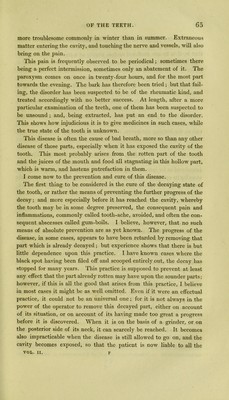
![The Stopping of the Teeth. If the destruction of the life of the tooth, either by drawing and re- storing it again, or by the actual or potential cauteries, has not been effected, and only the cure of the inflammation has been attempted, another method of preventing inflammation is to be followed, which is to allow as little stimulus to take place as possible. The cavity of the tooth not being capable of taking the alarm like most other cavities in the body, and of course not suppurating, as has been already observed, often no more is necessary, either to prevent the inflammation from taking place altogether, or extending further, than to exclude all ex- traneous irritating matter; therefore the stopping up the cavity be- comes, in many cases, the means of preventing future attacks of the inflammation, and often retards even the progress of the disease, that is, the further decay of the tooth, so that many people go on for years thus assisted: but it is a method which must be put in practice early, otherwise it cannot be continued long; for if the disease has done con- siderable damage to the inside of the tooth, so as to have weakened it much, the whole body of the tooth most probably will soon give way in mastication : therefore, under such circumstances, the patient must be cautioned not to make too free with the tooth in eating. Gold and lead are the metals generally made use of for stopping teeth. Gold being less pliable must be used in the leaf; lead is so soft in any form as to take on any shape by a very small force. surmountable objection exists to this operation, which is, that a dead extraneous body is thus forced into the alveolus, still sore from the operation, which must necessarily produce much irritation, and often suppuration, with all those severe symptoms which so often arise from dead roots, or from teeth whose connexion with the socket has been destroyed by a blow. The burning of the nerve is deserving of no better eulogy than the operation just mentioned. Hunter himself observes, with much naivete, that “ it must be done to the very point of the fang, which is not always possible.'' The truth is, that burning the pulp of a tooth even superficially, to be of service at all, must be done when the cauter- izing wire is at a white heat, or it otherwise only produces inflammation, and not the instantaneous destruction of the surface; but when the small size of the instrument, the distance which it must necessarily pass before it is brought into contact with the pulp, and the time which must elapse before it is applied, are considered, the impossi- bility of effectually employing this remedy is obvious. The other remedies here alluded to, and indeed all other caustic applications, are generally productive of more injury than benefit, and exacerbate rather than diminish the inflammation and pain. Leeches, purgative medicines, and the local application of narcotics, or camphor, &c., will often be beneficial; but, the pulp being once exposed, the relief which these afford can be but temporary, and the only remedy to be relied upon is the extraction of the tooth.]](https://iiif.wellcomecollection.org/image/b21996635_0002_0088.jp2/full/800%2C/0/default.jpg)