Chemistry, inorganic and organic : with experiments and a comparison of equivalent and molecular formulæ / by Charles Loudon Bloxam.
- Charles Bloxam
- Date:
- 1867
Licence: Public Domain Mark
Credit: Chemistry, inorganic and organic : with experiments and a comparison of equivalent and molecular formulæ / by Charles Loudon Bloxam. Source: Wellcome Collection.
37/748 page 9
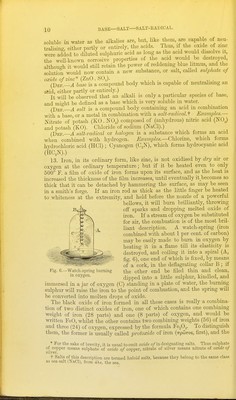
![solution is said to be neutral to test-papers, the alkali and the acid having neutralised each otlxer. (Def.—Neutralimtlou is the destruction of the characteristic properties of an acid by an alkali or the converse.) The liquid now contains a new substance called a salt (the strict defini- tion of which wiU be given hereafter), and known as sulphate of soda, which woidd be represented in symbols by NaO. SO3.* Now, it wiU be remembered that soda (NaO) is composed of 23 parts by weight of sodium and 8 parts of oxygen; hence 31 parts by weight would be represented by NaO. And sulphuric acid (SO3) is composed of 16 parts by weight of sulphiu-, and (8 x 3) 24 parts of oxygen, so that SO3 represents 40 parts by weight, and the combining weights of soda and (anhydi-ous) sulphuric acid are respectively 31 and 40. (Rule.—The combining loeights of comxMunds are obtained by adding together the iveights represented by their symbols.) All acids would not have neutralised the properties of the alkali, in the above experiment, so completely as sulphuric acid; thus carbonic acid woidd never entirely destroy the property of the soda to restore the blue coloiu: to reddened Litmus, although it would very considerably modify its other properties ; the solution of soda itself is capable of corroding the skin and textile fabrics, whence its old name of caustic soda, but when combined with carbonic acid, to form carbonate of soda, it loses these properties, and becomes what the older chemists called a mild alkali. Even the weakest acids possess this property of partially neutralising the alkalies. (Def.—An acid is a compound body which is capable of neutralising an alkali, either partly or entirely.) 12. Zinc wdl serve as an example of a metal which has no disposition to enter into combination with oxygen at the ordinary temperature,t but which is induced to unite with it by a very moderate heat. If a little zinc {spelter) be melted in a ladle or crucible, and stirred about with an iron rod, it bums with a beautifid greenish flame produced by the union of the vapour of zinc Avith the oxygen of the air. But the combustion is far more bril- liant if a piece of zinc-foil be made into a tassel (fig. 5), gently warmed at the end, dipped into a little flowers of sulphur, kindled, and let down into a jar of oxy- gen, when the flame of the burning sul- phur will ignite the zinc, wliich burns with great briQiancy. On withdrawing what remains of the tassel after the combustion is over, it will be foimd to consist of a friable^ mass, wliich has a fine yellow P'g-6--^c biunmg lu oxygen, colour while hot, and becomes white as it cools. This is the oxide of z'inc (ZnO), formed by the union of one combining weight (32-8 parts) of zinc with one combming weight (8 parts) of oxygen. The oxide of zinc does not possess the properties of an acid or an alkali, but belongs to another class of compounds termed bases, wliicli are not * Tri expressing by syniliols a compound of two or more compounds, thev 'iro ahvnvK separated from each other l,y a full stop. ' ^ ^ t lJ'>]fl«J* water and carlioiiic acid bo present, as in common air. X I'nahle, easily crnnibled or disintosratod.](https://iiif.wellcomecollection.org/image/b21496602_0037.jp2/full/800%2C/0/default.jpg)



 No text description is available for this image
 No text description is available for this image
 No text description is available for this image