Chemistry, inorganic and organic : with experiments and a comparison of equivalent and molecular formulæ / by Charles Loudon Bloxam.
- Charles Bloxam
- Date:
- 1867
Licence: Public Domain Mark
Credit: Chemistry, inorganic and organic : with experiments and a comparison of equivalent and molecular formulæ / by Charles Loudon Bloxam. Source: Wellcome Collection.
39/748 page 11
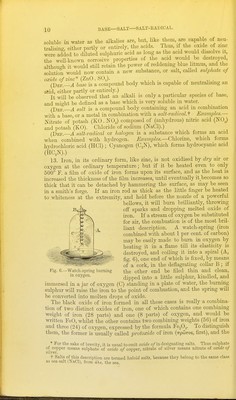
![latter sesqivioxide (in allusion to the ratio of one and a-half to one between the oxygen and the metal).* The sesquioxide of u-on combined with water constitutes ordinary rust. The black oxide usually contains one combiniug weight of each oxide, so that it would be written FeCFe^Oj, or re^O^. It is powerfully attracted by the magnet, and is often called magnetic oxide of iron. The abundant magnetic ore of iron, of which the loadstone is a variety, has a sinular composition. Iron in a very fine state of division will take fire spontaneously in air as certainly as phosphorus. Pyrophoric iron can be obtained (by a process to be described hereafter) as a black powder, which must be preserved in sealed tubes. When the tube is opened, and its contents thrown into the air, oxidation takes place, and is attended vdih. a vivid glow. In tliis case the red sesquioxide of iron is produced instead of the black oxide. Both these oxides of iron are capable of neutraHsuig, or partially neu- tralising, acids, and are therefore basic oxides or bases, like the oxides of zinc and sodium obtained in previous experiments. So general is the disposition of metals to form oxides of this class, that it may be regarded as one of the distinguishing features of a metal, for no non-metal ever forms a base with oxygen. (Def.—A metal is an element capable of forming a baset by combining with oxygen, or a salt by combining with a salt-radical.) Many metals are capable also of forming acids with oxygen; thus, tin forms stannic acid (SnOJ, antimony forms antimonic acid (SbO^), and it is always found that the acid oxide of a metal contains a larger proportion of oxygen than any of the other oxides which the metal may happen to form. 14. There is a third class of oxides, termed the indifferent oxides, be- cause they are neither acids nor bases; such oxides may be formed either by non-metals or metals; thus water (HO), the oxide of hydrogen, is an indifferent oxide, and the black oxide or binoxide of manganese (MnOJ is an example of an indifferent metallic oxide. It will be seen hereafter that the oxides of the non-metals are generally acids, and that when a metal combines with oxygen in several proportions, the oxides contain- mg the smallest proportion of oxygen are usually bases, whilst those con- tainmg the largest proportion are acids, and the indifferent oxides contain an mtermediate proportion of oxygen. The following list of the oxides of manganese wiU exemplify this, and will Ulustrate the names commonly bestowed upon oxides in order to indicate the proportion of oxvsen which they contain:— Protoxide of Manganese, . . MnO, Strong Base. Sesquioxide of „ . . UnJdo Weak Base. Binoxide, 1 . Peroxide,t ] • • MnOj Indifferent. Manganic Acid, .... MnO.^ Permanganic Acid, . . . Mn^O, 15. Preparation of Oxygen.—Fov almost all the iisoful arts in which uncombmed oxygen is required, the diluted gas contained in atmospheric sc^s-,u£xirteTir'™ ^^ fen-ic oxide are now very often substituted for protoxide and t The metal tung,sten appears at present to be an exception to this rule «r«ii defined basic oxide of this metal being known. * ®' ° t A peroxide is the highest oxide wTiich does not possess acid properties.](https://iiif.wellcomecollection.org/image/b21496602_0039.jp2/full/800%2C/0/default.jpg)



 No text description is available for this image
 No text description is available for this image
 No text description is available for this image