Chemistry, inorganic and organic : with experiments and a comparison of equivalent and molecular formulæ / by Charles Loudon Bloxam.
- Charles Bloxam
- Date:
- 1867
Licence: Public Domain Mark
Credit: Chemistry, inorganic and organic : with experiments and a comparison of equivalent and molecular formulæ / by Charles Loudon Bloxam. Source: Wellcome Collection.
53/748 page 25
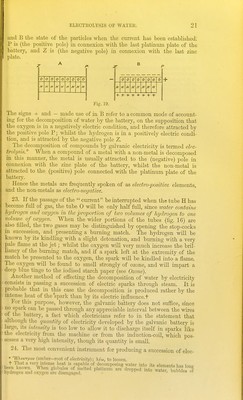
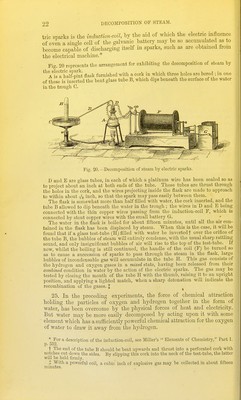
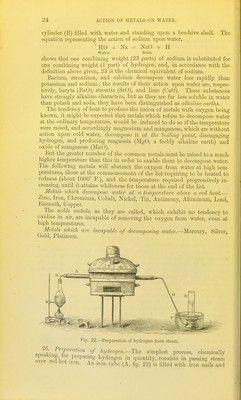
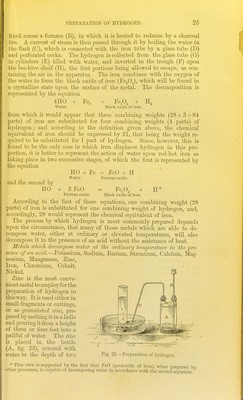
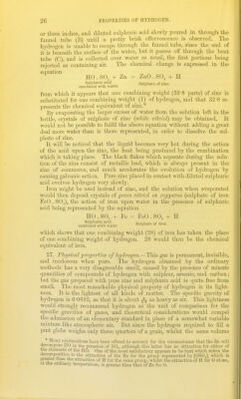
![lixod across a fiu'nace (B), in wliicli it is heated to redness by a charcoal lire. A cixrrent of steam is then passed through it by boiling the water in i lie tiask (C), wliicli is connected with the hon tube by a glass tube (D) ,iud perforated corks. The hydrogen is collected from the glass tube (G) in cylinders (E) filled with water, and inverted in the trough (F) upon the bee-hive shelf (H), the first portions being allowed to escape, as con- taining the air in the apparatus. The iron combines with the oxygen of the water to form the black oxide of iron (FegO.,), which will be found in a crystalline state upon the surface of the metal. The decomposition is represented by the equation 4H0 + Ye, = -Fe,0, + II, Water. Clack oxide of iron. fi'om which it woiild appear that tliree combining weights (28 x 3 = 84 parts) of iron are substituted for four combining weights (4 parts) of hydrogen; and according to the definition given above, the chemical equivalent of iron should be expressed by 21j that being the weight re- quired to be substituted for 1 part of hydrogen. Since, however, this is found to be the only case in wliich iron displaces hydrogen in this pro- portion, it is better to represent the action of water upon red-hot iron as talcing place in two successive stages, of which the first is represented by the equation HO + Fe = FeO -f H Water. Ferrous oxide. and the second by HO -f 3 FeO = Fe^O, -f H* Ferrous oxide. Black oxide of iron. According to the first of these equations, one combining weight (28 parts) of iron is substituted for one comloining weight of hydrogen, and, accordingly, 28 would represent the chemical equivalent of iron. The process by which hydrogen is most commonly prepared depends upon the circumstance, that many of those metals which are able to de- compose water, either at ordinary or elevated temperatures, wiH also decompose it in the presence of an acid without the assistance of heat. Metals which decompose ivater at the ordinary temperature in the pre- sence of an acid.—Potassium, Sodium, Barium, Strontium, Calcium, Mag- nesium, Manganese, Zinc, Iron, Chromium, Cobalt, Nickel. Zinc is the most conve- nient metal to employ for the preparation of hydrogen in this way. It is used either in small fragments or cuttings, or as granidated zinc, pre- pared by melting it in a ladle and ])ouring it from a height of three or four feet into a paUful of water. The zinc is placed in the bottle (A, fig. 23), covered with water to the depth of two * Thi.s view is supported by the fact tbat FcO (proto.xido of iron), wlion prepared b other processes, is capable of decomposing water in accordance with tlie sci ond equation. Fig. 23.—Preparation of hydrogen.](https://iiif.wellcomecollection.org/image/b21496602_0053.jp2/full/800%2C/0/default.jpg)
 No text description is available for this image
 No text description is available for this image
 No text description is available for this image