Chemistry, inorganic and organic : with experiments and a comparison of equivalent and molecular formulæ / by Charles Loudon Bloxam.
- Charles Bloxam
- Date:
- 1867
Licence: Public Domain Mark
Credit: Chemistry, inorganic and organic : with experiments and a comparison of equivalent and molecular formulæ / by Charles Loudon Bloxam. Source: Wellcome Collection.
54/748 page 26
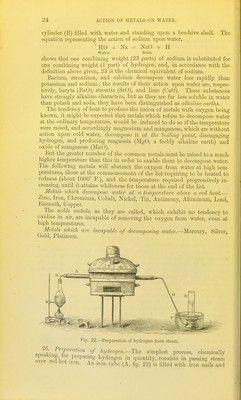
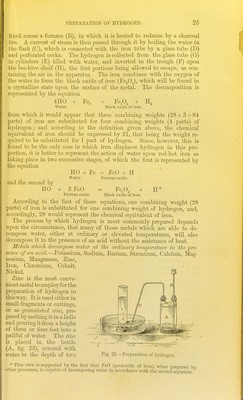
![or three inches, and dihited sulphuric acid slowly poured in through the funnel tube (B) until a pretty brisk effervescence is observed. The hydrogen is vmable to escape through the funnel tube, since the end of it is beneath the surface of the water, but it passes ofi' through the bent tube (C), and is collected over water as usual, the first portions being rejected as containing air. The chemical change is expressed in the equation HO . SO, + Zn = ZnO . SO3 + H Sitlphuric acid Sulphate of zinc combined with water. from which it appears that one combining weight (32-8 parts) of zinc is substituted for one combining weight (1) of hydrogen, and that 32-8 re- presents the chemical equivalent of zinc* By evaj)orating the larger excess of water from the solution left in the bottle, crystals of sidphate of zinc (white vitriol) may be obtained. It would not be possible to fulfil the above equation without adding a great deal more water than is there represented, in order to dissolve the sul- phate of zinc. It will be noticed that the liquid becomes very hot during the actioDr of the acid npon the zinc, the heat being produced by the combination which is taking place. The black flakes wliich separate during the solu- tion of the zine consist of metallic lead, which is always present in the- zinc of commerce, and much accelerates the evolution of hydrogen by causing galvanic action. Pure zinc placed in contact vvith diluted sulphuric acid evolves hydrogen very slowly. Iron might be used instead of zinc, and the solution when evaporated would then deposit crystals of green vitriol or copperas (sulphate of iron FeO. SOg), the action of iron upon water in the presence of sulphuric acid being represented by the equation HO . SO3 + Fe = FeO. SO3 + H Sulphuric acid c„i„i,„*„ „r combined with water. Sulphate of iron. which shows that one combining weight (28) of iron has taken the place of one combining weight of hydrogen. 28 would then be the chemical equivalent of iron. 27. Physical properties of hydrogen.—This gas is permanent, invisible, and inodorous when pure. The hydrogen obtained by the ordinary methods has a very disagreeable smell, caused by the presence of minute quantities of compounds of hydrogen with sulphur, arsenic, and carbon; but the gas prepared with pm-e zinc and sulphmic acid is quite free fi-oni smeU. The most remarkable physical jaroperty of hydi'ogen is its light- ness. It is the lightest of all kinds of matter. The specific gravity of hydrogen is 0'0692, so that it is about ^ as heavy as air. Tliis lightness would strongly recommend hydrogen as the imit of comparison for the specific gi-avities of gases, and theoretical considerations would compel the admission of an elementary standard in place of a somewhat variable mixture like atmospheric air. But since the hydrogen required to fiU. a pmt globe Aveiglis only three quarters of a grain, whilst tlie same volume * Many explanations liave been olTered to .account for tlie circumstance that the Zn will decompose HO in the presence of SO,, althougli tliis latter has no attraction for either of the elements of the HO. One of the 'most satisfactory appears to be that which refers the decomposition to the attraction of tlie Zn for the group represented by [OSO,], which is greater tlian the attraction of H for the .same group, whilst the attraction of H ibr 0 alone, at the ordmary temperature, is greater than that of Zn for 0.](https://iiif.wellcomecollection.org/image/b21496602_0054.jp2/full/800%2C/0/default.jpg)