Chemistry, inorganic and organic : with experiments and a comparison of equivalent and molecular formulæ / by Charles Loudon Bloxam.
- Charles Bloxam
- Date:
- 1867
Licence: Public Domain Mark
Credit: Chemistry, inorganic and organic : with experiments and a comparison of equivalent and molecular formulæ / by Charles Loudon Bloxam. Source: Wellcome Collection.
85/748 page 57
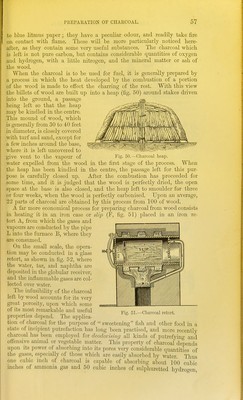
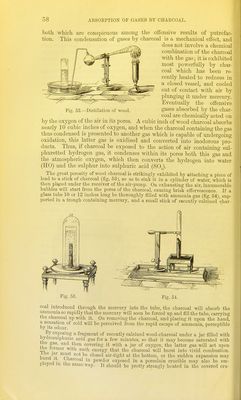
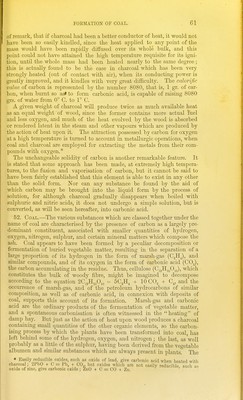
![10 blue litmus paper; they have a peculiar odour, and readUy take fire OH contact with flame. These will be more particularly noticed here- after, as they contain some very useful substances. The charcoal which is left is not pure carbon, but contains considerable quantities of oxygen and hydrogen, with a little nitrogen, and the mineral matter or ash of the wood. When the charcoal is to be used for fuel, it is generally prepared by a process in which the heat developed by the combustion of a portion of the wood is made to effect the charring of the rest. With this view the billets of wood are built up into a heajD (fig. 50) around stakes driven into the ground, a passage being left so that the heap may be kindled in the centre. This moimd of wood, which is generally from 30 to 40 feet in diameter, is closely covered with turf and sand, excejat for a few inches around the base, where it is left imcovered to give vent to the vapoiu' of Fig- 50.—CJiarcoal heap, water expelled from the wood in the first stage of the process. When the heap has been kindled in the centre, the passage left for this pur- pose is carefully closed up. After the combustion has proceeded for some time, and it is judged that the wood is perfectly dried, the open space at the base is also closed, and the heap left to smoulder for three or foui- weeks, when the wood is perfectly carbonised. Upon an average, 22 parts of charcoal are obtained by this process from 100 of wood. A far more economical process for preparing charcoal from wood consists in heating it in an iron case or sli]:) (F, fig. 51) placed in an iron re- tort A, from which the gases and vapours are conducted by the pipe L into the furnace B, where they are consumed. On the small scale, the opera- tion may be conducted in a glass retort, as shown in fig. 52, where the water, tar, and naphtha are deposited in the globular receiver, and the inflammable gases are col- lected over water. The infusibility of the charcoal left by wood accounts for its very great porosity, upon which some of its most remarkable and useful properties depend. The applica- Fig. 51.—Charcoal retort. tion of charcoal for the purpose of sweetening fish and other food in a state of incipient putrefaction has long been practised, and more recently charcoal has been employed for deodorisincj all kinds of putrefying and oflFensive animal or vegetable matter. This property of charcoal depends upon its power of absorbing into its pores very considerable quantities of the gases, especially of those which are easily absorbed by water. Tluis one cubic inch of charcoal is capable of absorbing about 100 cubic inches of ammonia gas and 50 cubic inches of sulphuretted hydrogen](https://iiif.wellcomecollection.org/image/b21496602_0085.jp2/full/800%2C/0/default.jpg)
 No text description is available for this image
 No text description is available for this image
 No text description is available for this image