Some nineteenth century Scotsmen : being personal recollections / by William Knight.
- William Angus Knight
- Date:
- 1903 [1902]
Licence: Public Domain Mark
Credit: Some nineteenth century Scotsmen : being personal recollections / by William Knight. Source: Wellcome Collection.
455/472 page 443
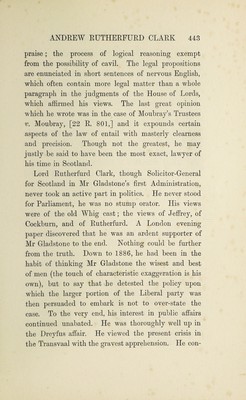
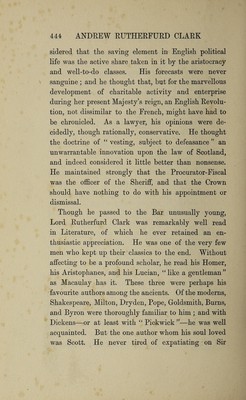
![praise; the process of logical reasoning exempt from the possibility of cavil. The legal propositions are enunciated in short sentences of nervous English, which often contain more legal matter than a whole paragraph in the judgments of the House of Lords, which affirmed his views. The last great opinion which he wrote was in the case of Moubray’s Trustees v. Moubray, [22 R. 801,] and it expounds certain aspects of the law of entail with masterly clearness and precision. Though not the greatest, he may justly be said to have been the most exact, lawyer of his time in Scotland. Lord Rutherfurd Clark, though Solicitor-General for Scotland in Mr Gladstone’s first Administration, never took an active part in politics. He never stood for Parliament, he was no stump orator. His views were of the old Whig cast; the views of Jeffrey, of Cockburn, and of Rutherfurd. A London evening paper discovered that he was an ardent supporter of Mr Gladstone to the end. Nothing could be further from the truth. Down to 1886, he had been in the habit of thinking Mr Gladstone the wisest and best of men (the touch of characteristic exaggeration is his own), but to say that he detested the policy upon which the larger portion of the Liberal party was then persuaded to embark is not to over-state the case. To the very end, his interest in public affairs continued unabated. He was thoroughly well up in the Dreyfus affair. He viewed the present crisis in the Transvaal with the gravest apprehension. He con-](https://iiif.wellcomecollection.org/image/b3135323x_0455.jp2/full/800%2C/0/default.jpg)
 No text description is available for this image
 No text description is available for this image
 No text description is available for this image