A compleat treatise on perspective, in theory and practice; on the true principles of Dr. Brook Taylor. Made clear, in theory, by various moveable schemes, and diagrams; and reduced to practice ... Containing diagrams, views, and original designs, in architecture, &c. ... All originals; / invented, delineated, and, great part, engraved by the author, Thomas Malton.
- Thomas Malton
- Date:
- 1778
Licence: Public Domain Mark
Credit: A compleat treatise on perspective, in theory and practice; on the true principles of Dr. Brook Taylor. Made clear, in theory, by various moveable schemes, and diagrams; and reduced to practice ... Containing diagrams, views, and original designs, in architecture, &c. ... All originals; / invented, delineated, and, great part, engraved by the author, Thomas Malton. Source: Wellcome Collection.
354/426 (page 254)
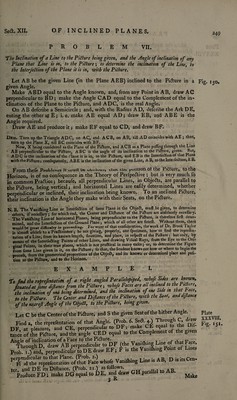
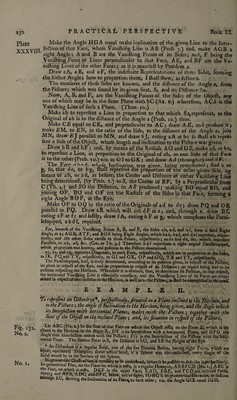
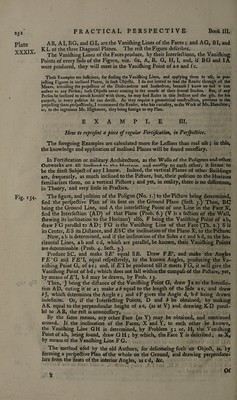
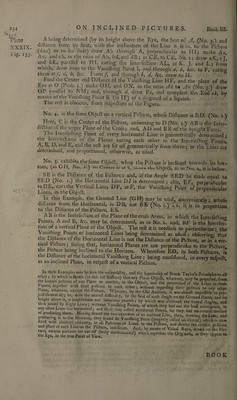
![> c > * Plate XXXIX. fig* 155* A being determined (by its height above the Eye, the Seat of Ar (No. qft) and diftance from its Seat, with the inclination of the Line it is in, to the Picture (dac) or to its Seat) draw Ab through A, perpendicular to HI; make A a, Ac, and cb, in the ratio of Ab, bd, and dB ; as CE, to CE, No. i ; draw aK, cj’ and bL, parallel to HI, cuting the In'terfe&ion AL, at K, ], and L; from which, draw lines to the Vanifhing Point I, and through a, b, &c. to F, cuting them at/, d, h, &c. From/ and through b, d, &c. draw to H. bind the Center and Diftance of the Vanifhing Line HF, and the place of the Eye at O (Prob. i;) make CM, and ON, in the ratio Ad to At (No. 3.) draw OP parallel to NM; and, through d, draw Pr, and compleat the End ek, by means of the Vanifhing Point R (in IF) of a diagonal of a Square. ’ The reft is obvious, from inflection of the Figure. No. 4. is the fame Objea on a vertical Piftme, whofe Diftance is ED. (No. 1.) Here, C is the Center of the Pi&ure, anfwering to D (No. 2.) AB is the Inter¬ feron of the upper Plane of the Crofs; and, AD and BE of the upright paces. I he Intel feeling Point of every horizontal Line is geometrically determined; the Interiedbons of the Planes cuting each other in the Interiedliug Points, A, B, D, and E, and the reft are fet oft geometrically from them ; or the Lines are determined, and proportioned, otherwile, as ufual. No. 5. exhibits the fame Object, when the Pifture is inclined towards its bot¬ tom, (as GH, No. 1.) its Center ic at S7 above the Object, as in No. 2, it is below. SE is the Diftance of the Picture; and, if the Angle SED be made equal to SED (No. i.) the Horizontal Line DI is determined; alfo, EF, perpendicular toDE, cuts the Vertical Line, DF, at F, the Vanifhing Point of perpendicular Lines, in the Objea. ’ '' rr In this Example, the Giound Line (GH) may be ufed, conveniently • whole diftance from the Horizontal, k DB, not EK (Nq. i.) i. e. it is in proportion to the Diftance of the Picture, ES. r F A B is the Interfedion of the Plane of the crofs Arms, in which the Interfd&no- Points, A and B, &c. may be determined, as in No. 2. and, BF is the Interfec* tion of a vertical Plane of the Objea. The reft it is needlefs to particularize ; tfte Vanifhing Points of horizontal Lines being determined as ufual; obferving,’that the Diftance of the Horizontal Line is not the Diftance of the Pnfture, as in a ver¬ tical Pi&ure ; feeing that, horizontal Planes are not perpendicular, to the Pi&ure the Picture being inclined to the Horizon. Wherefore ED, in both Piaures, is the Diftance of the horizontal Vaniftiing Line ; being confidered, in every refpea as an inclined Plane, in refpea of a vertical Piaure. ’ In thefe Examp.es may bn fecn the umverfality, and the fuperiority of Brook Taylor’s Principles to all other ; by which is fhewn (in this lafl Seaion) that any Plane Objea, whatever, may be projected, from the known pofition of one i lane to another, in the Objea, and the proportion of the Lines in thofe Planes, together with their pofition to each other ; without regarding their pofition to any other Plane whatever, except the P.<3ure. Whereas, by the Old Authors, it was almoft impoffrble to pro- hebrS'ah -r ^ ‘w utm°ftd;fficuI,T> by the Seat of each Angle on the GroundPp.]ane, and its W nh , b7 w2 f°? er0meanLd laborious procefs; by which was obtained the feveral Angles, and joinec y Lght Lines ; without \ anifliing Points, of which they had not the leaft conception in o?yproduciTrthem £T f “J ^ ^ ^ Poin* ** had ot pioducing them. Having .found the two extremes of an inclined Line, then, drawing the Line and fixed^^rf U, r°lthe ^°riZ0Ii5 they, f<bUnd lts Vanlfll’ng Point (properly called accidental) which is now an pi Ve° Hi'tT'T ^ T °f LbeS t0 ^Wur e' and diredts the cirtain. pofition n place of e«.ch Line on the Piaure, indefinite. And, by means of Vifual Ravs drawn on the Pic¬ ture, certain portions are cut off (truly mathematical^ whirb renrpfpnr f't ■ • i u the Eye, in the true Point of View. V ^ Vh dl RPreknt the Originals, as they appear to BOOK](https://iiif.wellcomecollection.org/image/b30456885_0354.jp2/full/800%2C/0/default.jpg)