A compleat treatise on perspective, in theory and practice; on the true principles of Dr. Brook Taylor. Made clear, in theory, by various moveable schemes, and diagrams; and reduced to practice ... Containing diagrams, views, and original designs, in architecture, &c. ... All originals; / invented, delineated, and, great part, engraved by the author, Thomas Malton.
- Thomas Malton
- Date:
- 1778
Licence: Public Domain Mark
Credit: A compleat treatise on perspective, in theory and practice; on the true principles of Dr. Brook Taylor. Made clear, in theory, by various moveable schemes, and diagrams; and reduced to practice ... Containing diagrams, views, and original designs, in architecture, &c. ... All originals; / invented, delineated, and, great part, engraved by the author, Thomas Malton. Source: Wellcome Collection.
387/426 (page 279)
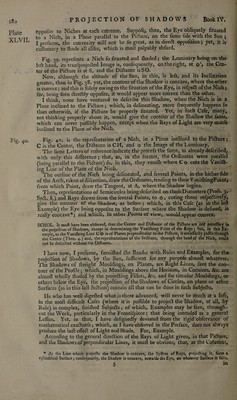
![BY THE SUN; ON CURVED SURFACES. EXAMPLE xiv. To projell the Shadow of the circular outline of a Nich, on the interior, fphcrical and cylindrical Surface. First ; let the Front of the Nich be parallel to the Pi&ure. C being the Center, draw Co, indefinite, the Interfedion of a Plane paffino- through the Luminary, perpendicular to the Piaure. F S R 7TanSent.to the Cu™e at A, parallel to C o, and feveral parallel Ordinates, BB DA&c. at difcretion. On the Diameters BE, DD, and EE, defcribethe re- presentationsi of Semicircles, in Planes whofe Vanifhing Line is C © (Prob. 2. Sea. 8A ( is its p]ftance) which are feaions of the Head, parallel amongft themfelves, and to their Plane of Shade, Fig. og t- 5s ^ Sre^JO? throuSh FA cut.s the cylindrical part of theNich, alfo, a!nd that through GG en- ^°fe Seasons are not Semicircles ; the former, where it cuts the Head, is circular, but where .iini'.rW (which only is wanted)' it is elliptical; and that through GG is a fcmi-EUipfes, whole tranfverfe Diameter is GL, and its Conjugate, the Diameter of the Nich. Defcribe the representations of fuch Ellipfes ; which being done, from B, D, (fee- draw Rays to o, curing the Curves, refpeaively, at b, d, &c. through which, defcribe the Curve A b d e f g, the Shadow of the exterior Curve (from A to G.) Draw gh, perpendicular, the Shadow of the edge GH, to which it is parallel, and join Hh; which compleats the whole Shadow, in that fituation of the Sun. If the Luminary be lefs inclined to the Plane of the Nich, but in the fame Plane of which Cl is the Vanifhing Line, its place being ©2; Aabdefgh is the Shadow, which has but little convexity, being farther removed from' the Curve of the Head, ABE. Pr0ce^s> though apparently troublefome, is the fhorteft of any that has yet been pub- Lined, and much more fimple than by vertical Sections, as exhibited in Fig. 39;* In which, the feveral Points, B, D, &c. in the Arch, by means of perpendiculars to the right Line IK, at the bottom, have correfporiding Points, B, D, Sec. Then (S, being the Seat of the Luminary) lines are drawn from B, D, &c. to S, cuting the curve of the bottom of the Nich, at b, d, &c. from which, perpendiculars are drawn to the Curve FGH, where the fpherical Surface begins; through which, the reprefentations of parallel Seftions are made (as in the Figure) a mod difficult procefs, as, each Curve is a different portion of a Circle. Right Lines from each Point, B, C, See. tending to Q3, (as in the former Figure) give the Shadow of each Point in its refpedive Se£tion; through which, the contour of the Shadow is defctibed. Sir William Chambers (if Fame reports true) was the firfl who took notice, in any publication in England, of this feeming paradox, viz. a convex Shadow of a concave Line; which, fince, has been moft fervilely copied, by almoft every Ar¬ chitect, or other Artifl, who had occafion to represent a Nich, either in external or internal Defigns. Yea, to fuch an extravagant excefs it is carried, that, in geo¬ metrical Sections, and where it is impoffible that the SUn fhould ever fhine, almofi every Nich is fo (haded; which, I do maintain, is, in fuch Cafe, moft unnatural; nor is the Shadow really convex, but only apparently fo; yet it is frequently exag¬ gerated, prepofteroufly. But, I prefume that, in Sun-fhine, it has not always the appearance of con¬ vexity ; for, I have (hewn (Fig. 38.) that, the lefs the Inclination of the Sun, to the Plane of the Front, the lefs convex is the Curve. There is, alfo, another cir- cumflance which occafions a different appearance. Thofe Authors, who have favoured the World with the method of deferibing it, have always given it direct, with (he Center of the Picture in the middle of the Nich, as in Fig. 38. But* certainly, in the Front of a Building, perfpe&ively delineated, the Eye cannot be * In this Example, Fournier is moft egregioufly miftaken; for, he makes all thefe vertical Se£lions pafs through B, the Vertex of the Nich, when it is evident, that they are parallel amongft themfelves, and to the Plane of Shade of perpendicular Lines. By which means, the contour of his Shadow is more convex than it can everpoflibly appear, in any fituation of the Luminary, and of the Spectator. y oppofite Fig. 39. I](https://iiif.wellcomecollection.org/image/b30456885_0387.jp2/full/800%2C/0/default.jpg)