A compleat treatise on perspective, in theory and practice; on the true principles of Dr. Brook Taylor. Made clear, in theory, by various moveable schemes, and diagrams; and reduced to practice ... Containing diagrams, views, and original designs, in architecture, &c. ... All originals; / invented, delineated, and, great part, engraved by the author, Thomas Malton.
- Thomas Malton
- Date:
- 1778
Licence: Public Domain Mark
Credit: A compleat treatise on perspective, in theory and practice; on the true principles of Dr. Brook Taylor. Made clear, in theory, by various moveable schemes, and diagrams; and reduced to practice ... Containing diagrams, views, and original designs, in architecture, &c. ... All originals; / invented, delineated, and, great part, engraved by the author, Thomas Malton. Source: Wellcome Collection.
400/426 (page 292)
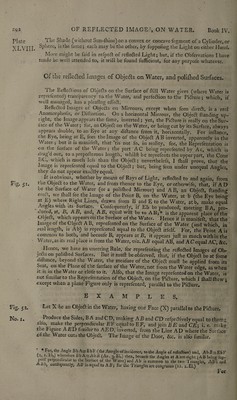
![2Q2 Plate xlviil Fig. 51.. Fig. 52. No. i. i OF REFLECTED IMAGES, ON WATER. Book IV. The Shade (without Sun-fhine)on a convex or concave Segment of a Cylinder, or Sphere, is the fame; each may be the other, by fuppofmg the Light on either Hand. More might be Laid in refped of refieded Light; but, if the Obfervations I have made be well attended to, it will be found fufficient, for any purpofe whatever. Of the reflected Images of Obje&s on Water, and polifhed Surfaces. The Reflexions of Objeds on the Surface of Rill Water gives (where Water is reprefen ted) tranfparency to- the Water, and perfection to the Pidure; which, if well managed, lias a pleallng effect, Lefleded Images of Objects on Mirrours, except when feen dired, is a real Auamoiphohs, or Dihortion. On a horizontal IVIirrour, the Objed Handing up¬ right, the Image appears the fame, inverted ; yet, the Pidure is really on the Sur¬ face of the Water ; for, an Objed on the Water, or being cut by its Surface, always appears double, to an Eye at any diftance from it, horizontally. For inftance, the Eye, being at E, fees the Image of the Objed AB inverted, apparently in the Water; but it is manifeff, that ’tis not fo, in reality, for, the Reprefentation is on the furface of the Water; the part AC being reprefen ted by Ac, which is drag d out, to a prepofterous length, whilft be reprefents the upper part, the Cone 1C, which is much iefs than the Objed; neverthelefs, I fhall prove, that the Image is reprefen ted equal to the Object; but, being feen under unequal Angles, they do not appear exactly equal. , It is obvious, whether by means of Rays of Light, refieded to and again, from toe Objed to the Water, and from thence to the Eye, or otherwiie, that, if A D he the Suiface of Water (or a polifhed Mirrour) and AB, an Objed, ftanding ereff, we (hall fee the Image of the Point B, on the Water, at b (the Eye being at E) w here Right Lines, drawn from B and E to the Water, at b, make equal Angles with its Surface. Confequently, if Eb be produced; meeting BA, pro¬ duced, at, B, AB, and, AB, equal will be to ABj* is the apparent place ofthe Objed, which appears on the Surface of the Water. Hence it is manifeff, that the Image of the Cbjed A b, reprefented on the Surface of the Water (and which, in real length, is Ab) is reprefented equal to the Objed itfeif. For, the Point A is common to both, and becaule B, appears at B, it appears juft as much within the Water, as its real place is from the Water, m, AB equal AB* and A C equal AC, &c. Hence, we have an unerring Rule, for rep refen ting the refleded Images of Ob- jeds on polifhed Surfaces. But it muff be obferved, that, if the Objed be at fome diftance, beyond the Water, the meafure of the Objed muff be applied from its Seat, on the Plane of the furface of the Water, not from the Water edge, as when it is in the Water or clofe to it. Alfo, that the Image reprefented on the Water, is not fimilar to the tieprefentation of the Objed, on the Pidure, which 1 fhall fhewj except when a plane Figure only is reprefented, parallel to the Pidure. examples. Let X be an Objed in the Water, having one Face (X) parallel to the Pidure. 1 f roduce the Sides, BA and CD, making AB and CD refpedively equal to them; alio, make the perpendicular £F equal to EF, and join BE and CE; i. e. make the Figure A£D fimilar to AED, inverted, from the Line AD where the Surface .of the Water cuts the Objed. dhe Image of the Door, &c. is alfo fimilar. / * FoLr? ,AngI-e hbA = EbF (die Anngle of incidence, to the Angle of refieflionf and, Ab£—EbF (2. 1. tJ.) wherefore BbA — AbA (Ax. 3. El.) then, becaufethe Angles at A are right (AB being fup- ] o: perpendicular to the Surface of the Water) and Ab is common to the two Triangles, ABb and j, .conlcquently, AB as equal to A B ■, for tlie Triangles are congruous (u. i.EL) For](https://iiif.wellcomecollection.org/image/b30456885_0400.jp2/full/800%2C/0/default.jpg)