Doctors of Samuel Johnson and his court / by James P. Warbasse.
- James Peter Warbasse
- Date:
- 1908
Licence: In copyright
Credit: Doctors of Samuel Johnson and his court / by James P. Warbasse. Source: Wellcome Collection.
Provider: This material has been provided by The Royal College of Surgeons of England. The original may be consulted at The Royal College of Surgeons of England.
29/58 (page 27)
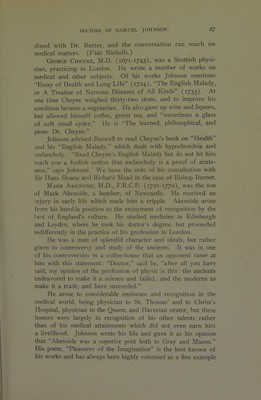
![dined with Dr. Butter, and the conversation ran much on medical matters. (Vide Nicholls.) George Cheyne, M.D. (1671-1743). was a Scottish physi- cian, practicing in London. He wrote a number of works on medical and other subjects. Of his works Johnson mentions “Essay of Health and Long Life” (1724), “The English Malady, or A Treatise of Nervous Diseases of All Kinds” (i733)- At one time Cheyne weighed thirty-two stone, and to improve his condition became a vegetarian. He also gave up wine and liquors, but allowed himself coffee, green tea, and “sometimes a glass of soft small cyder.” He is “The learned, philosophical, and pious Dr. Cheyne.” Johnson advised Boswell to read Cheyne’s book on “Health” and his “English Malady,” which dealt with hypochondria and melancholy. “Read Cheyne’s English Malady but do not let him teach you a foolish notion that melancholy is a proof of acute- ness,” says Johnson. We have the note of his consultation with Sir Hans Sloane and Richard Mead in the case of Bishop Burnet. Mark Akensiue, M.D., F.R.C.P. (1721-1770), was the son of Mark Akenside, a butcher, of Newcastle. He received an injury in early life which made him a cripple. Akenside arose from his humble position to the enjoyment of recognition by the best of England’s culture. He studied medicine in Edinburgh and Leyden, where he took his doctor’s degree, but proceeded indifferently in the ])ractice of his profession in London. He was a man of splendid character and ideals, but rather given to controversy and study of the ancients. It was in one of his controversies in a coffee-house that an opponent came at him with this statement; “Doctor,” said he, “after all you have said, my opinion of the profession of physic is this: the ancients endeavored to make it a science and failed; and the moderns to make it a trade, and have succeeded.” He arose to considerable eminence and recognition in the medical world, being physician to St. Thomas’ and to Christ’s Hospital, physician to the Queen, and Harveian orator, but these honors were largely in recognition of his other talents rather than of his medical attainments which did not even earn him a livelihood. Johnson wrote his life and gave it as his opinion that “Akenside was a superior poet both to Gray and Mason.” His poem, “Pleasures of the Imagination” is the best known of his works and has always been highly esteemed as a fine example](https://iiif.wellcomecollection.org/image/b22460718_0031.jp2/full/800%2C/0/default.jpg)