Catalogue of the collections / Comp. by E.M. Holmes.
- Pharmaceutical Society of Great Britain. Museum
- Date:
- 1878
Licence: Public Domain Mark
Credit: Catalogue of the collections / Comp. by E.M. Holmes. Source: Wellcome Collection.
Provider: This material has been provided by The University of Leeds Library. The original may be consulted at The University of Leeds Library.
56/320 (page 44)
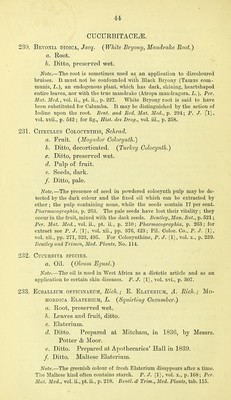
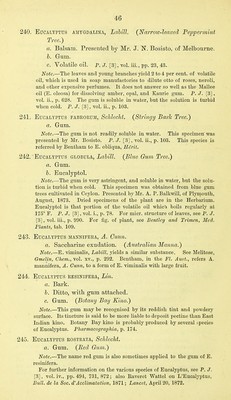
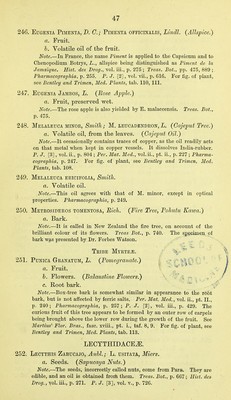
![CUCURBITACE^. 230. Bryonia dioica, Jacq. (White Bryony, Mandrake Boot.) a. Root. b. Ditto, preserved wet. Note.—The root is sometimes used as an application to discoloured bruises. It must not be confounded with Black Bryony (Tamus com- munis, L.), an endogenous plant, which has dark, shining, heartshaped entire leaves, nor with the true mandrake (Atropa mandragora, L.). Per. Mat. Med., vol. ii., pt. ii., p. 227. White Bryony root is said to have been substituted for Calumba. It may be distinguished by the action of Iodine upon the root. Bent, and Red. Mat. Med., p. 294; P. J. [1], vol. xvii., p. 542 ; for fig., Hist, des Drog., vol. iii., p. 258. 231. Citeullus Coloctnthis, Sdirad. a. Fruit. (Mogador Colocynth.) b. Ditto, decorticated. (Turkey Culocyntli.) c. Ditto, preserved wet. d. Pulp of fruit. e. Seeds, dark. /. Ditto, pale. Note.—The presence of seed in powdered colocynth pulp may be de- tected by the dark colour and the fixed oil which can be extracted by ether; the pulp containing none, while the seeds contain 17 per cent. Pharmacographia, p. 263. The pale seeds have lost their vitality; they occur in the fruit, mixed with the dark seeds. Bentley, Man. Bot., p. 521; Per. Mat. Med., vol. ii., pt. ii., p. 210; Pharmacographia, p. 263; for extract see P. J. [1], vol. xii., pp. 376, 423; Pil. Coloc. Co., P. J. [1], vol. xii., pp. 271, 323, 495. For Colocynthine, P. J. [1], vol. x., p. 239. Bentley and Trimen, Med. Plants, No. 114. 232. CtJCURBITA SPECIES. a. Oil. (Oleum Eguse.) Note.—The oil is used in West Africa as a dietetic article and as an application to certain skin diseases. P. J. [1], vol. xvi., p. 307. 233. Ecballium OFFICINARUM, Rich.; E. Elaterium, A. Midi.; Mo- mordica Elaterium, L. (Squirting Cucumber.) a. Root, preserved wet. b. Leaves arid fruit, ditto. c. Elaterium. d. Ditto. Prepared at Mitcham, in 1836, by Messrs. Potter & Moor. e. Ditto. Prepared at Apothecaries' Hall in 1839. /. Ditto. Maltese Elaterium. Note.—The greenish colour of fresh Elaterium disappears after a time. The Maltese kind often contains starch. P. J. [1], vol. x., p. 168; Per. Mat. Med., vol. ii., pt. ii., p. 218. Bentl. d Trim., Med. Plants, tab. 115.](https://iiif.wellcomecollection.org/image/b21512668_0056.jp2/full/800%2C/0/default.jpg)