Quarterly report on the progress of segregation camps and medical treatment of sleeping sickness in Uganda. For the quarter December 1st, 1907-February 29th, 1908 / A. C. H. Gray. With an introduction by A. D. P. Hodges.
- Hodges, A. D. P.
- Date:
- 1908
Licence: In copyright
Credit: Quarterly report on the progress of segregation camps and medical treatment of sleeping sickness in Uganda. For the quarter December 1st, 1907-February 29th, 1908 / A. C. H. Gray. With an introduction by A. D. P. Hodges. Source: Wellcome Collection.
Provider: This material has been provided by London School of Hygiene & Tropical Medicine Library & Archives Service. The original may be consulted at London School of Hygiene & Tropical Medicine Library & Archives Service.
34/40 (page 32)
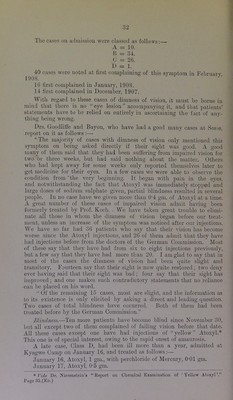
![The cases on admission were classed as follows:— A = 10. B = 34. = 26. D = 1. 40 cases were noted at first complaining of this symptom in Februarv 1,908. 16 first complained in January, 1908. 14 first complained in December, 1907. With regard to these cases of dimness of vision, it must be borne in mind that there is no “ eye lesion ” accompanying it, and that patients’ statements have to be relied on entirely in ascertaining the fact of any- thing being wrong. Drs. Gpodliffe and Bayon, who have had a good many cases at Sesse, report on it as follows :— “The majority of cases with dimness of vision only mentioned this symptom on being asked directly if their sight was good. A good many of them said that they had been suffering from impaired vision for two or three weeks, but had said nothing about the matter. Others who had kept away for some weeks only reported themselves later to get medicine for their eyes. In a few cases we were able to observe the condition from 'the very beginning. It began with pain in the eyes, and notwithstanding the fact that Atoxyl was immediately stopped and large doses of sodium sulphate given, partial blindness resulted in several people. In no case have we given more than 0'4 gm. of Atoxyl at a time. A great number of these cases of impaired vision admit having been formerly treated by Prof. Koch. . We have taken great trouble to elimi- nate all those in whom the dimness of vision began before our treat- ment, unless an increase of the symptom was noticed after our injections. We have so far had 36 patients who say that their idsion has become worse since the Atoxyl injections, and 26 of them admit that they have had injections before from the doctors of tlie G-ermau Commission. ]\Iost of these say that they have had from six to eight injections previously, but a few say that they have had more than 20. I am glad to say that in most of the cases the dimness of vision had been quite slight and transitory. Fourteen say that their sight is now quite restored; two deny ever having said that their sight was bad; four say that their .sight has improved; and one makes such contradictory statements that no reliance -can be placed on his word. “ Of the remaining 15 cases, most are sliglit, and the information as to its existence is only elicited by asking a direct and leading question. Two cases of total blindness have occurred. Both of them had been treated before by the German Commission.” Blindness.—Ten more patients have become blind since November 30, but all except two of them complained of failing vision before that date. All these cases except one have had injections of “yellow” Atoxyl.* This one is of special interest, owing to the rapid onset of amaurosis. A late case. Class D, had been ill more than a year, admitted at Kyagwe Camp on January 16, and treated as follows:— January 16, Atoxyl, 1 gm., with perchloride of Mercury, O’Ol gm. January 17, Atoxyl, Q-5 gm. * T^ide Dr. Niorenstein’s “Keporfc on Chemical Examination of ‘Yellow Atoxyl’.’’ Page 35.(Ed.)](https://iiif.wellcomecollection.org/image/b2491616x_0036.jp2/full/800%2C/0/default.jpg)