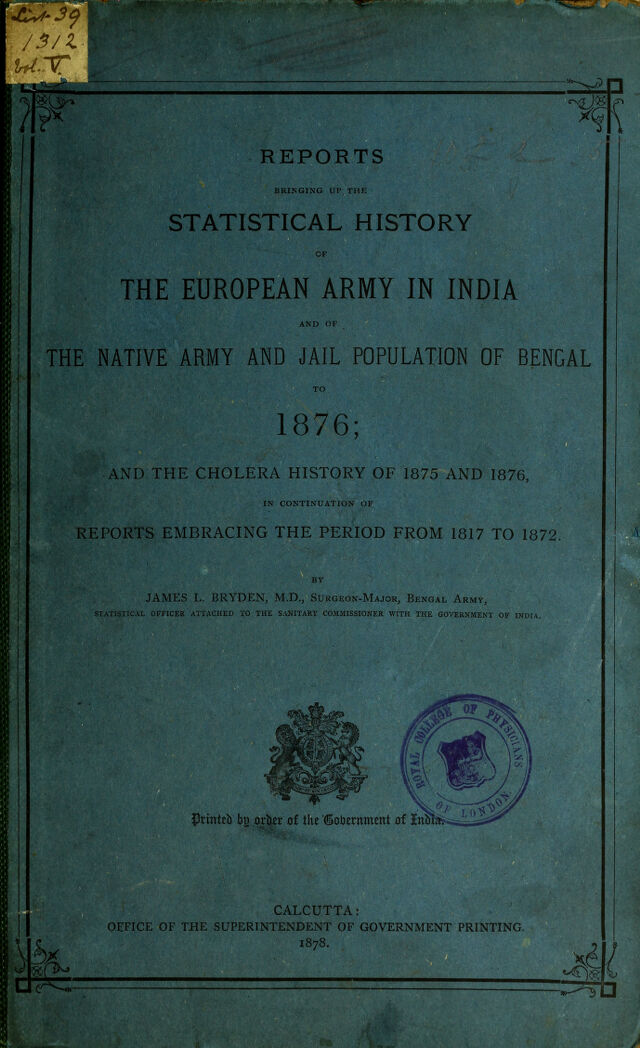
Reports bringing up the statistical history of the European Army in India and of the Native Army and jail population of Bengal to 1876 : and the cholera history of 1875 and 1876, in continuation of reports embracing the period from 1817 to 1872 / by J.L.Bryden.
- James Bryden
- Date:
- 1878
Licence: Public Domain Mark
Credit: Reports bringing up the statistical history of the European Army in India and of the Native Army and jail population of Bengal to 1876 : and the cholera history of 1875 and 1876, in continuation of reports embracing the period from 1817 to 1872 / by J.L.Bryden. Source: Wellcome Collection.
Provider: This material has been provided by Royal College of Physicians, London. The original may be consulted at Royal College of Physicians, London.
14/358
![Page Importance of distinguisliing the different varieties of yellow fevers ....... 180 Epidemic malaria has a history, general and local. A single locality may be taken as typical for a great natural province .............. ]go The Seharunpore district as typical, taking the epidemics from 1810 onwards. The epidemics from 1810 to 1870, were generally and provincially, as weU as locally manifested . • . . 180 The succession of epidemics of malarious fevers— Epidemic of 1809 181 Epidemic of 1816 181 Epidemic of 1829 181 Epidemic of 1834 .............. i82 Epidemic of 1840 182 Epidemics from 1850 onwards 18^ Association of the fever of Lower Bengal with the fever of Upper India ...... 183 Localisation of epidemic malaria in Upper India. The subject illustrated ...... 183 Localised malaria is not allied in its nature to enteric fever. Cases of Her Majesty's 85th and 79th Regiments ................ 18,3 The association of epidemic malarious fever with famines and contagious fevers. Epidemic periods . 184 Malarious fevers, famine and contagious fevers between 1815 and 1820. Famine of 1818 . . . 184 Epidemic malaria preceding the famine. The epidemic fever in the Gangetic Provinces and in Northern and Western India .............. 184 Eelapsing contagious fever of the same period. In Upper India in the jails of Moradabad, Seharun- pore and Allahabad 185 Typhus and relapsing fever of the period in Western India ......... 186 Alliance of the malarious epidemics of Madras with those of Northern India, epidemics of 1810, 1816 and 1833-34 . . 186 Epidemic malaria, typhus and famine of 1833-38 .......... 186 Scurvy preceding the outbreak in Western India ........... 187 Typhus general over Northern and Western India 187 Details illustrating the character of the fever of 1836 and 1837 in Upper India ..... 187 Typhus of the Agra Jail of the spring and hot months of 1838 ........ 187 Epidemic malaria, relapsing fever and famine, 1859-66 ......... 188 The epidemic of malaria of October 1859 in the Valley of the Ganges—Behar Provinces . . . 188 „ „ Eastern Bengal ........... 188 „ „ Benares, Ghazipore, Mirzapore 189 Saugor and other tracts of Central India ...... 189 „ „ Nerbudda Valley 190 Comparative immunity of the jails in all districts affected ......... 190 Loss of a Province during an epidemic of malarious fever. Punjab, 1869-70 ..... 190 Epidemic malaria of 1859. Its geographical limit to the west. The jails affected by relapsing fever were beyond this limit 190 The relapsing fever of 1859-66, probably received its main impetus from the occurrence of famine in 1860-61. Its geographical distribution .......... 191 Meteorology predisposing to the development of diseases of the typhus group in India . . . .191 In all epidemic periods several distinct varieties of fevers of the typhus group appear .... 191 The occurrence of diseases of the typhus class, in connection with the appearance of malarious epidemics, suggests the necessity for keeping the fact ia view in studying the pandemic spread of fevers 191 27/6 Aspects in Communities of Fevers of the Typhus Class. Diseases of the typhus-group may change their type in a community, A continued typhus of the spring may reappear as a relapsing fever in the next cold season ...... 191 Continued yellow typhus 191 The Variety in which the force of the poison is thrown on the lungs. Illustrations from the different historical typhus periods ............. 192 Bubo plague of the Himalayas and Western India .......... 193 Pneumonic typhus, as seen in British Regiments during the last typhus period ..... 193 Eelapsing fever of a Native Eegiment cantoned in the same station, parallel in time with the pneumonic fever of the Europeans ... ........ 193 Description of this fever as typical for relapsing typhus ... ...... 194 Eelapsing typhus as described by Hippocrates ........... 194 Epidemic dysentery (? typhus) of Her Majesty's 19th Eegiment, which occurred at Amritsar in 1863, when typhus prevailed .............. 195 The only case of contagious dysentery in our European records of the past 20 years. Parallels in former times 196 Dysenteric typhus, the offspring of relapsing typhus, of the Amritsar Jail, of 1864 .... 196 Nature of the contagious dysentery and fever of Her Majesty's 96th Eegiment, which suffered at Lahore in 1852 and 1853 196 Dinapore dysentery of 1849-50 197 Enteric typhus (?), in which the lower portion of the small intestine is alone involved . . . 197 The specific character and insidious nature of relapsing contagious fever; the method of its introduction into jails illustrated. Allyghur, Agra and Umballa jails ....... 197 The germ of an outbreak introduced months before, is apt to be overlooked in consequence of the temporary decay of the typhus poison 199 Influence of season on the manifestation of contagious fevers. The contagious fevers of India run parallel in season with those of Egypt ........... 199 Typhus in vessels leaving Calcutta during typhus periods. Typhus of Reunion ..... 200 The natural alliances of typhus. The importance of the study of these alliances .... 200 The mortality following the introduction of relapsing fever into jails, shown in the results of 51 out- breaks; and the seasons of its commencement, culmination and decay illustrated . . . 202 Contagious fever is almost invariably present among the free community before it appears in jails . 205 Why precautions and sanitary measures have failed to cut short these jail outbreaks .... 205 TABULAR STATEMENTS COKTAINED IN SECTION III. Deaths and Death-rates of Administrations. Comparative Statement in two nine-year periods, and for each of the 18 years from 1859 to 1876 156](https://iiif.wellcomecollection.org/image/b24749333_0014.jp2/full/800%2C/0/default.jpg)


 No text description is available for this image
 No text description is available for this image
 No text description is available for this image