Reports bringing up the statistical history of the European Army in India and of the Native Army and jail population of Bengal to 1876 : and the cholera history of 1875 and 1876, in continuation of reports embracing the period from 1817 to 1872 / by J.L.Bryden.
- James Bryden
- Date:
- 1878
Licence: Public Domain Mark
Credit: Reports bringing up the statistical history of the European Army in India and of the Native Army and jail population of Bengal to 1876 : and the cholera history of 1875 and 1876, in continuation of reports embracing the period from 1817 to 1872 / by J.L.Bryden. Source: Wellcome Collection.
Provider: This material has been provided by Royal College of Physicians, London. The original may be consulted at Royal College of Physicians, London.
187/358 (page 167)
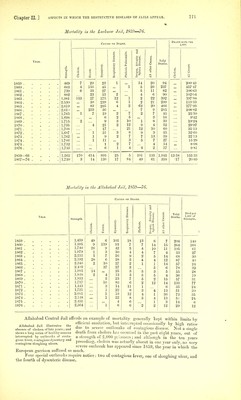
![Mortality of the Jail at Monghjr contrasted in the two periods, 1859—67 and 1868—76. Cholera Deaths. Total Mortality. Death- rate per 1,000. Years. Strength. Cholera Deaths. Total Mortality. Death- rate per 1,000. 1859 . 444 18 64 144-1 1868 . 354 ... IJ 31-1 T D /5 n 4Ui 19 0/ lb ri looy OOO OW O 1861 . 288 8 46 159-7 1870 . 323 i 7 21-7 1862 . 269 ]4 49 1S2 2 1871 . 279 1 8 28-7 1863 . 380 '39 171 450-0 1872 . 299 9 30-1 1864 . 362 16 44-2 1873 . 374 10 26-7 1865 . 378 6 21 55-6 1874 . 375 11 29-3 1866 . 468 6 38 81-2 1875 . 380 14 22 57-9 1867 . 394 8 25 63-4 1876 . 383 6 15-7 3,384 118 497 146-9 3,123 16 98 31-4 It is very interesting to see how, with the general improvement, cholera has ceased to appear annually in this jail,—a phenomenon parallel with that quoted in the cholera section o£ this report, as illustrating the extraordinary contrast in the cholera death-rate of the Central Jails of the North-Western Provinces in the periods 1859-67 and 1868-76. The diminution shown in the death-rate is from 147 to 31 per 1,000. It is, however, necessary to qualify this statement as far as the ratio is affected by the deaths of 1863. A gang of prisoners, about 100 strong, was brought from Kungpore for change, and in order to relieve overcrowding. Twenty per cent, of the strength had died in the Rungpore Jail in 1862, and fatal disease had stricken down many of the survivors. The Civil Surgeon of Monghyr mentions, that of this gang scarcely any were alive at the end of 1863. The Backergunge, Rungpore, and Dinagepore Jails are typical for unhealthy jails of Bad jans of Northern and Eastern Eastern Bengal.* These are_ jails specially liable to suffer in Bengal which always show a high consequence of the geographical position which they occupy, death-ratio. Illustrations. rpj^gy are essentially unhealthy jails. The Backergunge Jail has not failed in any one year to localise cholera when the cholera season has come round. In six years only out of the eighteen, the death-rate of the Backergunge Jail has been under 10 per cent, of the average strength; in the Rungpore Jail, also, in seven years only has the mortality been below the same rate of 10 per cent.; and in Dinagepore, a comparatively healthy jail of late years, in eight out of the eighteen years, a minimum of 9 per cent, was exceeded. Within the last nine years Backergunge has reduced the mortality from 149 to 101 per 1,000. Rungpore remains at 128 in both nine-year periods. Dinagepore shows in the late years a death- rate of 56, brought down from 122. ' Here we have to deal with local and endemic conditions always at hand to take advantage of any weakness. The following statement shows the form in which the endemic causes of disease manifest themselves. It may be taken as typical for the region of in thesT-dK ^ ''''''^ perennial moisture, where the ever-existing conditions tell slowly and surely on the constitution, and with very little variation in intensity from month to month. In the ten years 1867—76,977 prisoners died in the Backergunge and Rungpore Jails. From cholera 114 died, and 9 deaths from violence occurred. The 854 deaths remaining were made up thus—dysentery, 469 ; phthisis, iUO ; fevers, 71 ; dropsy, 64 ; respiratory diseases, 44; atrophy, 37 ; spleen disease, 19 ; apoplexy, 7 ,- heart disease, 6 ; hepatitis, 4 ; scurvy, 1; and aU other causes, 32. In the 1,000, these causes of mortality were pi-oportioned thus :—■ Dysentery and Diarrhoea. 549 Phthisis. Fevers. Dropsy. 117 83 75 Eespiratory Diseases. 52 Atrophy. 43 Spleen Disease. 22 All other Causes. 59 = 1,000 Dr. Herbert Baillie, then in charge of the Alipore Jail, gives in his report for 1858, the following very vivid description of the method in which cachectic prisoners die in the jails of Lower Bengal. It thoroughly illustrates the figures of the preceding table. He writes : Most of those who died laboured not under one, but a complication of diseases, arising from a cachectic state of the system. A prisoner is relieved of an attack of dyspepsia and is sent back to jail. After a while, he returns to hospital with diarrhoea or dysentery. His aspect has much altered in the interval. Anasarca of the extremities and perhaps swelling of the face, is observed. After a few weeks, serous effusion into the peritoneum occurs; the diarrhoea or dysenteric affection is relieved, but an attack of bronchitis or pleurisy or perhaps pneumonia, sets in. This has to be combated, the dropsical tendency all the while increasing. The kidneys then are possibly found affected, and at last the poor wretch dies completely worn out. After death, if not detected during life, tubercles or even tubercular cavities are often found, which have served to hasten the termination of the case. Such was the progress in many of the fatal cases recorded. * See Tables XXIV and XXVI.](https://iiif.wellcomecollection.org/image/b24749333_0189.jp2/full/800%2C/0/default.jpg)